As with other commodities, markets could help us efficiently produce machine intelligence.The Bittensor (TAO) Whitepaper, 2021
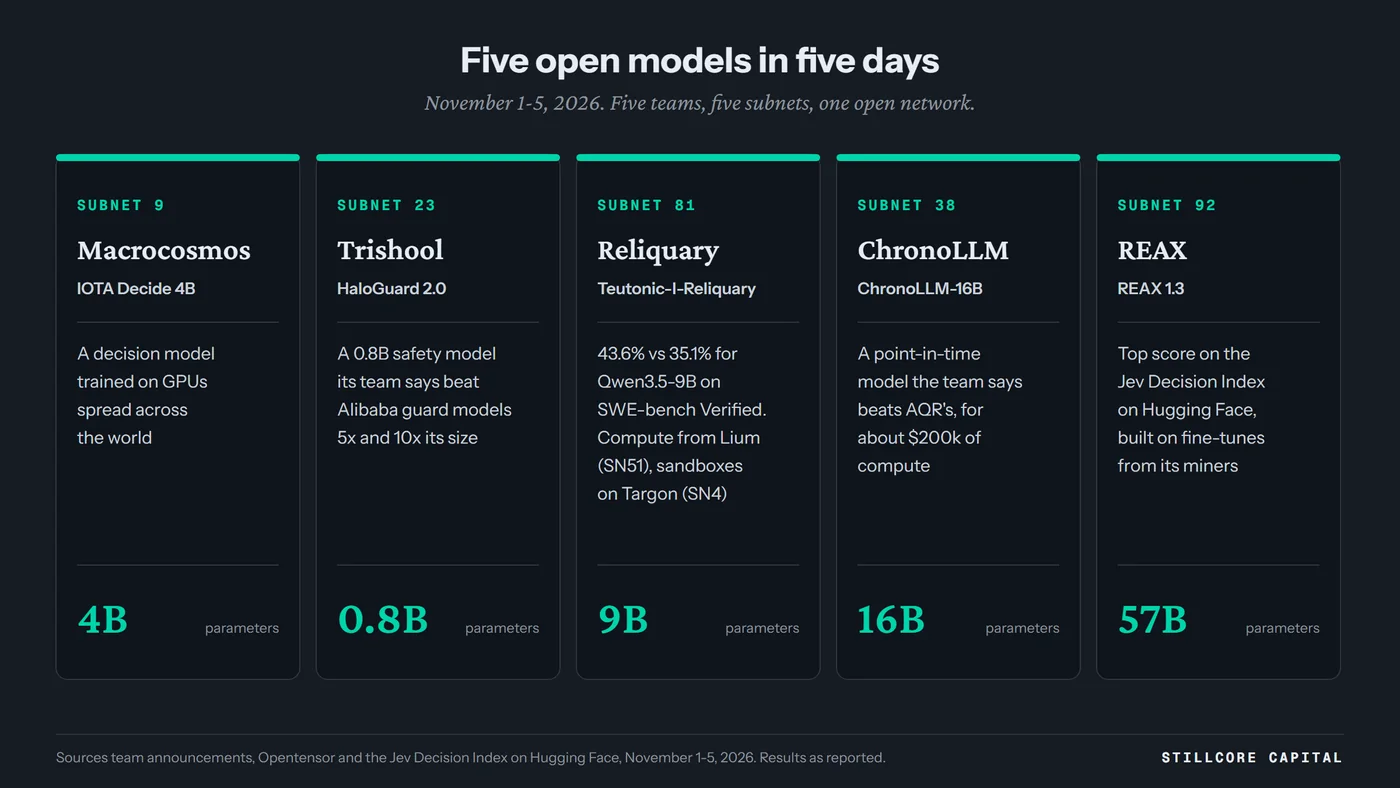
In the first five days of November, five teams on one open network shipped five open models, and the four with published results sit on or near the Pareto frontier for their size. One of them, a 57 billion parameter decision model, topped a public leaderboard, and Bittensor's co-founder Jacob Steeves pointed out that it "was also trained by anonymous engineers on the internet through a mining network."
Days earlier, Will Manidis and Joe Roberts had published The Commanding Heights, a book-length essay on who'll own the economy once intelligence gets cheap. They define commanding heights as "scarce, controllable positions of economic power whose holders durably capture the gains of increasingly capable and diffused intelligence." The industry building the models won't hold one, they argue, because it'll keep spending on itself as its returns fall, which turns intelligence into a commodity priced near the cost of the computing power behind it. As with the railroads, the bigger fortunes get made outside the industry that builds the technology.
Their geopolitics follows the same logic. Only America and China will be real sovereigns, every other country becomes what they call an exarchate, dependent on one superpower's models, and stablecoins carry the dollar to people who've never held an American bank account. "In the world to come," they write, "one either owns the rails or pays those who do."
The prize is enormous. Intelligence is an input to nearly every kind of work, so we believe the economy built on it won't be one more industry like cloud computing or semiconductors. It'll be orders of magnitude larger than today's entire economy, and the positions that collect its tolls could become the most valuable ever held.
We agree with nearly the entire thesis. But the essay never mentions Bittensor, and having argued that the toll on cheap intelligence won't go to the model makers, it never says where that toll gets collected. We believe it's collected in the market where intelligence is produced, priced, and paid for. Bittensor, an open network that pays tens of thousands of miners and validators, human or AI, to build and run AI, is that market in working form, and TAO, the token it's all priced in, is how an investor owns it. On November 6, TAO was worth about $2.5 billion. The rest of this piece holds our answer to the standards Manidis and Roberts set, starting with where a height can sit at all.
1. Where the Height Sits
The phrase is Lenin's. In November 1922 he told the Fourth Congress of the Communist International that the Soviet state could let private traders back into the economy because it still held the commanding heights, the branches through which everything else flowed. For most of the twentieth century, governments agreed those branches belonged to the state, and then the planners lost. Friedrich Hayek had explained why in 1945. The knowledge an economy runs on is scattered across millions of people in fragments no planner can gather, and prices are how those fragments reach one another. Daniel Yergin and Joseph Stanislaw told the story of markets taking the heights back in their 1998 book of the same name.
A frontier lab isn't a state, but inside its own walls it allocates the way a planner does, deciding in one company what to build, what to train, and what to charge. Stargate is central planning for compute. Applied to intelligence, Hayek's argument rules out the two places most investors look for the height. It can't sit in a model, because every answer a closed model sells can train a cheaper imitator through a process called distillation, and each advance by the leading labs has reappeared in free open models within months, and by one recent measure within weeks. It can't sit in a building either. A gigawatt data center campus draws as much power as a city, and it needs a utility, a permit, a transmission line, thousands of tradespeople, and a single owner willing to finance all of it. Each of those is a point where the project can be delayed, regulated, or switched off.
The height sits where intelligence is bought and sold. When a product becomes a commodity, its producers earn commodity margins and the durable franchise belongs to the exchange, the way wheat farmers earned commodity returns while the Chicago Board of Trade became one of the great franchises in American finance (90 Days Liquidity makes the case at length in The Last Moat). If models are the wheat, the commanding height is the exchange. An exchange for intelligence has to do more than match buyers and sellers, though. The product doesn't exist until someone gets paid to make it, so the exchange has to commission the work, grade it, and pay for it, and Bittensor is built to do all three, with prices set by tens of thousands of miners and validators rather than a committee inside one firm.
2. How Bittensor Makes Intelligence
Bittensor is easiest to understand as a supply chain in which each link is a market. Each market, called a subnet and known by its number on the network, pays participants called miners to do one kind of work. Validators, weighted by the TAO staked to them, score that work, and the network pays out only for what they judge useful. At the base of the chain sit the raw commodities of AI. Lium (SN51) and Targon (SN4) supply computing power, and Targon's machines can prove to a buyer exactly what software they're running, while Beam (SN105) moves data and Hippius (SN75) stores it, on hardware the miners bring themselves.
Above them sit the training markets. Teutonic and IOTA (SN9) pretrain models, the expensive first stage of building one, by paying miners to train them across GPUs linked by ordinary internet connections, and IOTA has already run a two-day test of a 100 billion parameter model that way. Post-training subnets such as Affine (SN120), Reliquary (SN81), and TrajectoryRL (SN11) pay miners to make open models better at specific skills, and Trishool (SN23), ChronoLLM (SN38), and REAX (SN92) do the same for safety, forecasting, and decisions. Affine's miners, for example, post-trained Alibaba's open 35 billion parameter Qwen3.6 into Affine-1, which by Affine's measure scores about 23 on Artificial Analysis's intelligence index, up from 18 for the base model and roughly level with Claude Opus 4.1, a frontier model Anthropic released in August 2025. At the top, inference networks such as Chutes (SN64) and Engy (SN53) serve the finished models to paying customers. Each subnet has its own token, and on the network each of those tokens is priced only against TAO. A model can move from rented GPUs to a working service, priced at every step in one asset, without a contract, a cloud account, or anyone's permission.
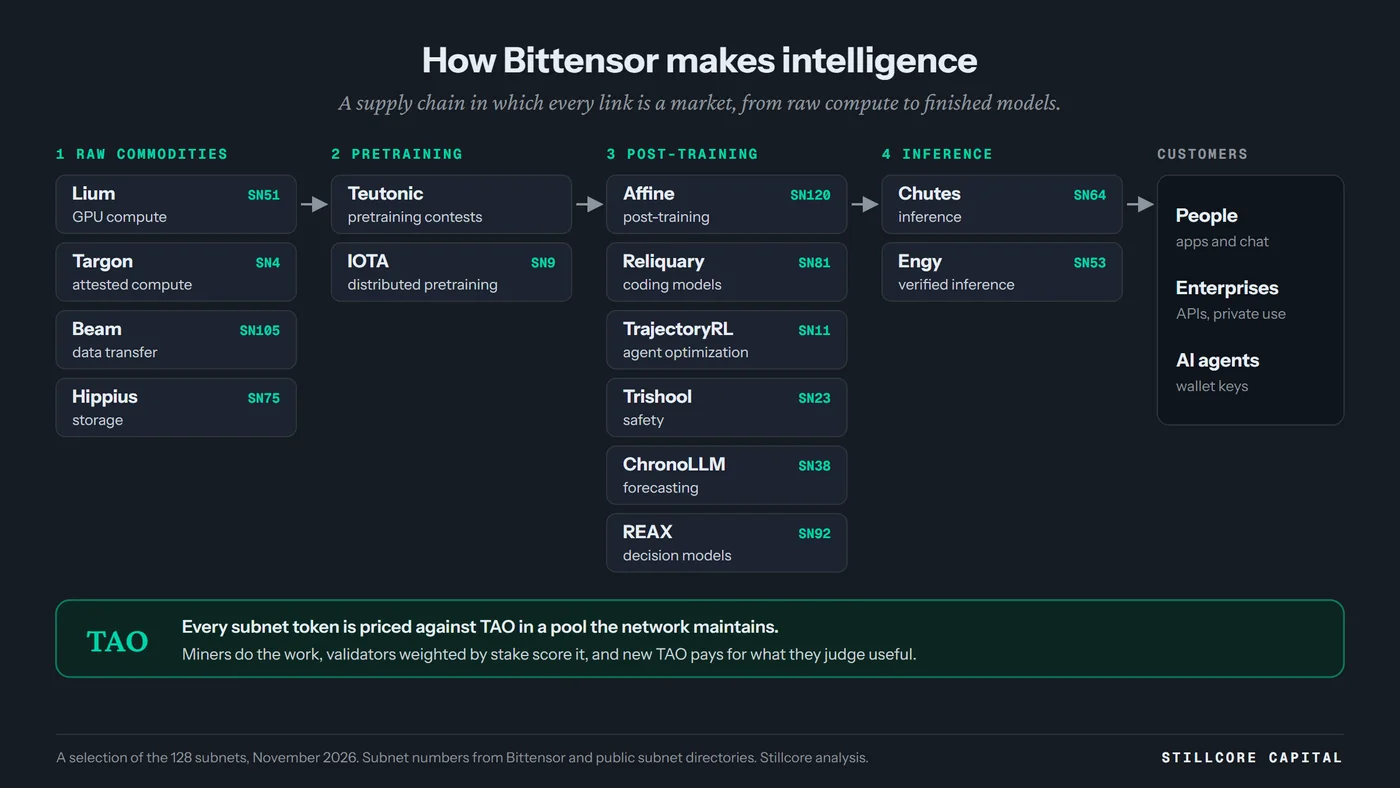
The closest analogy is the early web, whose open protocols let anyone publish but couldn't be owned by anyone, so its wealth went to the companies built on top of it. Bittensor is a worldwide web of intelligence whose protocol has an asset anyone can own, and because every subnet token trades only against TAO, demand for anything built on top has to pass through it.
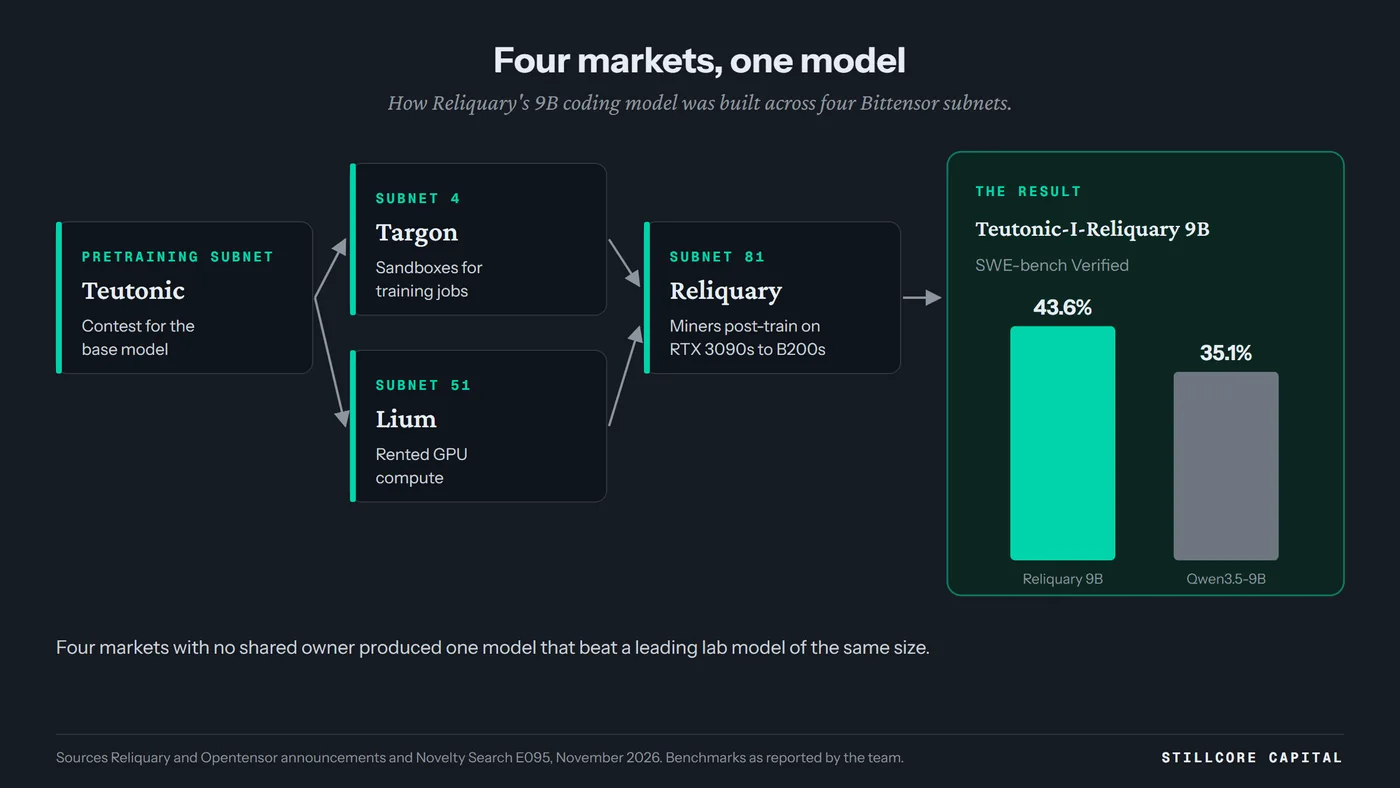
This fall showed what the chain can produce. Reliquary's 9 billion parameter coding model was pretrained in a contest on Teutonic, trained in Targon's sandboxes on GPUs rented through Lium, and post-trained by Reliquary's own miners on hardware from RTX 3090s to B200s, a mix of cards no data center would put in one training run, and a breakthrough for heterogeneous compute. Four markets with no common owner built one model. On SWE-bench Verified, a widely reported test of whether a model can fix real bugs in real software, the team reports a score of 43.6% against 35.1% for Alibaba's Qwen3.5-9B, a model of the same size.
Four other subnets shipped models in the same five days. Trishool's 0.8 billion parameter safety model, its team says, outscored Alibaba's guard models at five and ten times its size. Macrocosmos released IOTA Decide 4B, a decision model trained on GPUs spread around the world. ChronoLLM trains one model for each year from 1999 to 2026 so a backtest never sees the future, and its team says its 16 billion parameter model beats the closest equivalent from the quant giant AQR for a couple hundred thousand dollars of compute. REAX's 57 billion parameter decision model, built on fine-tunes from its miners, topped the Jev Decision Index on Hugging Face. The four with published results sit on or near the Pareto frontier, the curve that marks the best performance available at a given size and cost, and they were built by people paid by a protocol rather than employed by a lab.
Customers are paying for the output. SubConnect, an index that tracks subnet revenue from public and self-reported figures, put the subnets' combined revenue at an annual rate of $28-35 million when it launched in late summer, about $50 million in October, and about $70 million on November 4. We believe the true figure is higher. We believe much of it comes from customers who pay in dollars and never touch a token. GPU rental leads, and Lium rented out $2.32 million of GPU time in October, up 74% in a month. At that pace one subnet brings in about $28 million a year, roughly 40% of the index, and a market outside customers already pay for is far harder to route around than one only its own participants use.
3. What It Costs to Route Around
Manidis and Roberts separate a commanding height from a passing bottleneck by durability. "Unlike fleeting bottlenecks," they write, "a Height durably captures a share of the economic activity it enables, and the multiplication of that activity further entrenches the Height." A model fails that test, because whatever it captures today a rival can distill tomorrow, at a cost that falls every quarter. Bittensor's code fails it too, since anyone can copy open-source code to start a rival network. What a copy can't take is everything built on the code, from the miners and the validators with years of scoring history to the money in the network's pools, the paying customers, and the property that makes the network more valuable as it grows, which is that subnets build on one another.
Bitcoin's value is often modeled with Metcalfe's law, under which a network's value grows with the square of its users, since each user can pay any other. David Reed observed in 1999 that a network whose members can form groups gains value far faster, because the number of possible groups doubles with each member who joins. Ten members can make 45 connections but about a thousand groups, and twenty can make 190 connections but about a million groups. The strong form of Reed's law overstates real networks, since most possible groups never form. It describes Bittensor well, though, once the groups are understood as production pipelines, chains of subnets that use one another's output. Bitcoin connects payers, while Bittensor combines producers. Reliquary's model drew on four subnets, and a subnet launched tomorrow can combine with any of the 128 already running, so each addition creates new possible pipelines. A pipeline that works sends paying demand back to the subnets it draws on, and this web of pipelines is the multiplication Manidis and Roberts describe. It's the moat, because a copy of the code inherits none of it.
Durability also means surviving a break in the cryptography, and Bittensor's speed is an advantage there. Chamath Palihapitiya, the investor and All-In co-host, has offered the sharpest bear case on crypto we've heard this year, that a self-improving AI could be turned against old Bitcoin wallets until Bitcoin "eventually gets hacked and then it goes to zero." An AI and a quantum computer are different threats aimed at the same lock. Most crypto wallets, Bitcoin's and Bittensor's included, are secured by elliptic-curve signatures. A large enough quantum computer could break them with an algorithm published in 1994, once the hardware exists. An AI would have to find a classical shortcut that nobody has found in the roughly forty years since elliptic-curve cryptography was proposed. Either route would hit first the coins whose public keys are already visible on the chain. For Bitcoin that includes many of its oldest wallets. For Bittensor it means every account, since a Bittensor address is its public key.
Release 487, Bittensor's next upgrade, is set to add signatures that don't use elliptic curves and a way to move a wallet to a fresh key, so a wallet that moves is safe from a break in that math by either route. Bitcoin's developers still haven't agreed on how to make the same move. No signature scheme is safe forever, so what counts is how quickly a network can switch, and Bittensor still has a core team that ships. Steeves has said he plans to hand control of the network's rules to the network itself by around the end of 2027.
4. Who Else Can Claim the Rent
Manidis and Roberts expect the state to claim part of the rent from any height it can reach. It'll meter access to the most capable models, take stakes in the labs that build them, and control those labs "without formally announcing nationalization." Washington has already used both tools elsewhere, taking a golden share in U.S. Steel and a stake of nearly 10% in Intel in 2025. June showed how little announcement it takes. On June 12, after the Commerce Department issued an export-control directive, Anthropic suspended access to its most capable public models for nearly three weeks, and the companies that had built on them learned their access existed at a government agency's discretion.
The physical constraints are political too. Lead times for large power transformers have stretched from months to as long as four or five years, gas turbines are sold out for years, and after this month's midterms the next Congress will hear from voters about power bills, water, and local control whenever a gigawatt campus is proposed. Those pressures push compute toward smaller sites in more places and more countries. Arm's chief executive has said the rest of the world is ready to build whatever America hesitates on, and Box's Aaron Levie points out that agent inference can run almost anywhere. Compute scattered that way is hard for any one company to coordinate, and it's exactly what a protocol is built to pool. Steeves has made that argument for years.
Outside America the lesson lands harder. Governments from France, which announced €109 billion of private AI investment in February 2025, to Britain, India, and Saudi Arabia are writing sovereign AI strategies, and Switzerland released Apertus, a fully open national model with its weights, data, and training recipes published. In June, Palantir and Nvidia launched a Sovereign AI Operating System built on Nvidia's open Nemotron models. Companies want the same control. Coinbase fine-tuned an open model on its own fraud data for under $100, and Kirkland & Ellis is putting $500 million into an AI platform that runs on its own GPUs.
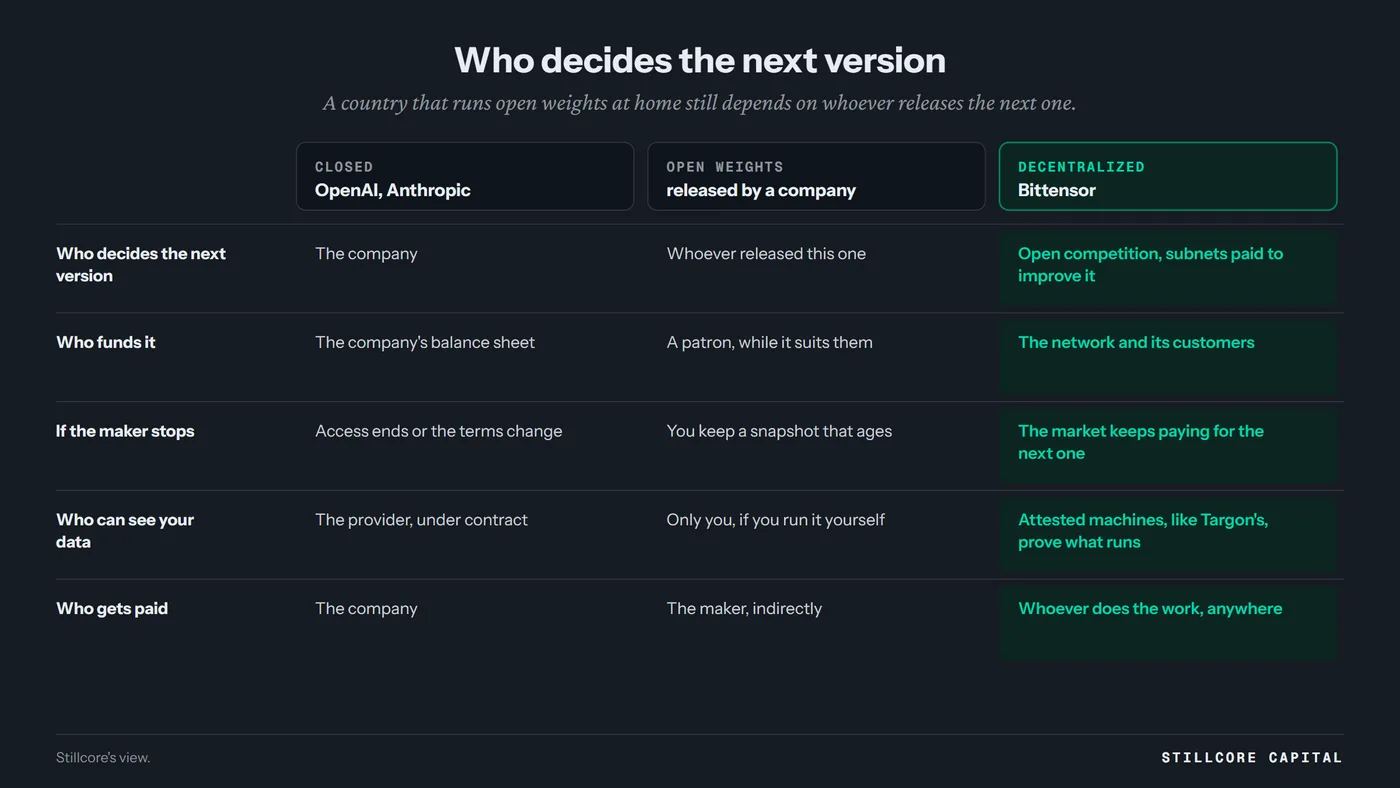
Manidis and Roberts expect every country except America and China to become an exarchate, and the obvious escape is to download an open model and run it at home, where no foreign government can switch it off. The weakness is that an open model is a snapshot, and whoever released it decides whether there's a next version. Meta has already said it'll be careful about what it open-sources from here, as section 7 shows, and China's free releases are a subsidy that will eventually want a return. A country that wants the next model, and the one after that, without depending on Washington, Beijing, or a single company needs a way to keep producing intelligence that nobody controls. A network anyone can join, with its rules moving out of any one party's hands, supplies exactly that. Sovereign means decentralized.
5. Who Pays the Toll
In late October, OpenAI's Sam Altman told Stripe's John Collison on the Cheeky Pint podcast that memory sitting idle in personal computers is a poor use of a scarce resource next to the same memory working around the clock in a data center. The clip spread without its context, and the backlash was loud enough that he clarified a few days later that he wants people to have as much memory as they like.
On the narrow point, though, Altman's right. Most of the world's computing hardware sits idle most of the time, and in a memory shortage that idleness is expensive. His conclusion, that the memory would do more good in a data center, holds only if no market can put idle hardware to work where it sits, and Bittensor's compute subnets are that market. They buy capacity that people and data centers would otherwise leave idle. Because a paid-off GPU's main running cost is electricity, much of that supply keeps running through price slumps that would break an operator on borrowed money, and as the token rises, pricier capacity becomes worth plugging in. The network's supply grows with its value instead of its borrowing.
The buyers are changing as fast as the sellers. Cloudflare's chief executive said in June that automated traffic now exceeds human traffic on the internet and could reach a thousand times human traffic within five years. An AI agent is an awkward customer for a cloud provider, because it can't open a bank account, sign an enterprise contract, or pass a credit check. It can hold a key and pay per request, though, and that's the customer Bittensor's subnets are built to serve. Release 487 is set to add Gamma, which lets a buyer burn, or permanently destroy, a subnet's token for dollar-valued credits for that subnet's compute, inference, or storage. The buyer spends the credits through its wallet key, with a designated spender and an optional daily cap, so an agent can budget in dollars and buy intelligence without an account, a contract, or a person in the loop. Each dollar of service bought that way takes the seller's tokens out of circulation, and we believe agents will end up holding TAO for the reason people do, as an asset they can own without anyone's permission that grows with the economy they work in.
6. What TAO Tokenizes
Calling TAO tokenized intelligence should mean something specific. Bittensor mines intelligence the way Bitcoin mines security. The network issues new TAO every day and routes it into subnets, which pay their miners in their own tokens for whatever work validators judge useful, so issuance is a standing bid for intelligence. Gamma completes the picture from the buyer's side. Once a subnet's token can be swapped for a fixed dollar value of that subnet's service, it's a claim on real output, and each of those claims is priced against TAO in a pool the network maintains. TAO is therefore the asset a growing basket of claims on the production of intelligence is priced in, closer to an index of the network's output than a currency.
The link between that output and TAO's price is mechanical. On the network, a subnet's token can be bought only with TAO, so a subnet that earns dollars and wants to buy back its token has to buy TAO on the open market first and put it into the subnet's pool. When the subnet burns the tokens it bought, the TAO stays in the pool. Every dollar of revenue spent that way is a purchase of TAO, and by Crypto Briefing's count in September, 14 of the roughly two dozen subnets with outside revenue were already buying back their own tokens. Any other purchase of a subnet token, whether by a speculator or a customer buying Gamma credits, runs through TAO the same way, which is why our Bittensor Thesis calls TAO an index of the entire ecosystem. Subnets have their own reason to buy, since their miners are paid in the subnet's token at a fixed rate, so a subnet that wants more or better capacity has to raise what each token is worth. We believe the network will go further next year and make outside revenue an input to how new TAO is allocated, tying issuance directly to paying demand.
TAO's supply borrows from Bitcoin on purpose, with a hard cap of 21 million tokens, nothing set aside for insiders before launch, and halvings at fixed supply milestones. The first came in December 2025 at 10.5 million tokens, the same mark where Bitcoin had its first halving in November 2012, when a bitcoin cost about $12. About 11.7 million TAO exist today. Bitcoin reached that supply in September 2013, at about $124 a bitcoin, and passed $1,000 before the year was out. That's history rather than a forecast, but it shows what a supply shock looks like when demand is just beginning to arrive. Our Thesis adds the other half, that a token used only to settle payments changes hands too fast to hold its value, so it's demand like those buybacks that gives anyone a reason to hold TAO.
That makes TAO and Bitcoin complements rather than rivals. Bitcoin hedges the debasement of money, and we believe TAO hedges the commoditization of intelligence and gets paid by it, which earns it a place beside Bitcoin in any portfolio built for the AI era.
7. The AI Intelligentsia Is Describing It
The people who run and fund the AI industry have, between them, made nearly every part of this argument in public. Most have never said the word Bittensor and none has endorsed it. That's what makes the overlap worth reading, since each of them spoke for their own reasons, about their own business.
It starts with the premise that intelligence is becoming a commodity. Altman wrote in his essay Three Observations that "the cost to use a given level of AI falls about 10x every 12 months, and lower prices lead to much more use." When DeepSeek's cheap model rattled markets, Microsoft's Satya Nadella invoked the Jevons paradox and predicted AI's use would skyrocket, turning it into "a commodity we just can't get enough of." Two companies with huge bets on closed frontier models are run by people who expect the price of what they sell to keep falling. That's the economics Manidis and Roberts build on, and the reason a durable toll is unlikely to sit with a model.
Open models, meanwhile, have some of the industry's biggest backers. In July, Nvidia, Microsoft, Meta, Mistral, Palantir, IBM, Andreessen Horowitz, Hugging Face, Mozilla, and the Linux Foundation signed a letter titled Open Weights and American AI Leadership, and Anthropic didn't sign. In March, Nvidia had gathered Mistral, Perplexity, Cursor, Thinking Machines, India's Sarvam, and others into a coalition to build open frontier models. The White House AI Action Plan of July 2025, which credits David Sacks as special advisor for AI and crypto, has a section titled "Encourage Open-Source and Open-Weight AI." Mark Zuckerberg made the case in 2024 in an essay called Open Source AI Is the Path Forward.
That section title names the catch. Many of today's open models are open weight, meaning the finished model is free to download while the data and the full recipe behind it stay with the company that made it, and that company decides whether there's a next one. A year after his essay, laying out Meta's plan for what he calls personal superintelligence, Zuckerberg wrote, "We'll need to be rigorous about mitigating these risks and careful about what we choose to open source." Widely used open models come from Alibaba, DeepSeek, Meta, and Nvidia, and the next version of each depends on its maker still wanting to pay for it, which is the snapshot problem from section 4 in its plainest form.
The people closest to the research describe the alternative in terms that could have come from Bittensor's own documentation. In March, Andrej Karpathy, a founding member of OpenAI, released autoresearch, a system in which AI agents run training experiments on their own. The next step, he wrote, was to make it massively collaborative across many agents, in the style of SETI@home, the volunteer project that pooled home computers to search for signals from space, because "the goal is not to emulate a single PhD student, it's to emulate a research community of them." Researchers at Google DeepMind argued last December, in a paper called Distributional AGI Safety, that general intelligence may first appear as a patchwork of specialized agents coordinating as one, kept safe by governing the trades between them through market design. The timing matters, since The Wall Street Journal reported in October that Demis Hassabis, DeepMind's co-founder, now expects AGI within two to three years. Balaji Srinivasan, Coinbase's former chief technology officer, calls AI polytheistic rather than monotheistic and "empirically decentralizing rather than centralizing." Even Gavin Baker of Atreides Management, who expects most of the value to go to the most capable models, has described a future of many models with a frontier model conducting the rest. We believe a market will do the conducting.
One exchange put those ideas next to Bittensor by name. In March, on the All-In podcast, which our partner Jason Calacanis co-hosts, in an episode recorded at Nvidia's GTC conference, Chamath described a model trained on "this crypto project called Bittensor Subnet 3," built "totally distributed" by people contributing spare compute, and called it "a pretty crazy technical accomplishment." Nvidia's chief executive, Jensen Huang, answered, "Our modern version of Folding@Home," a nod to the effort that borrowed spare home computers to simulate how proteins fold.
Countries and people want to own that intelligence rather than rent it. In February 2024 Huang told the World Governments Summit in Dubai that a country's own AI "codifies your culture, your society's intelligence, your common sense, your history," and Nvidia's account of the talk leads with the line "Every country needs to own the production of their own intelligence." Palantir's chief executive, Alex Karp, has been telling governments to own their models, data, and compute rather than rent them. This April the AI Alliance, a group of more than 200 member organizations, launched Project Tapestry so its members can build sovereign models without pooling their data in one place, and named Yann LeCun, the Turing Award winner who founded Meta's AI research lab, its chief science advisor. People feel it too. When Altman's memory clip spread, Beff Jezos, a founder of the effective accelerationism movement, put the backlash this way on November 4. "The reason people reacted against centralized data centers is that they need to feel like they own a piece of the future."
Investors who think hard about money are reaching the same place. On Peter Diamandis's podcast in October, Chamath argued that a fiat currency can only be debased so far before value has to be measured another way, in the energy and compute held in data centers, power plants, and turbines, and he guessed that a crypto token would stand for a unit of access to them. Once Release 487 adds Gamma, each subnet's token becomes that kind of unit, priced in TAO.
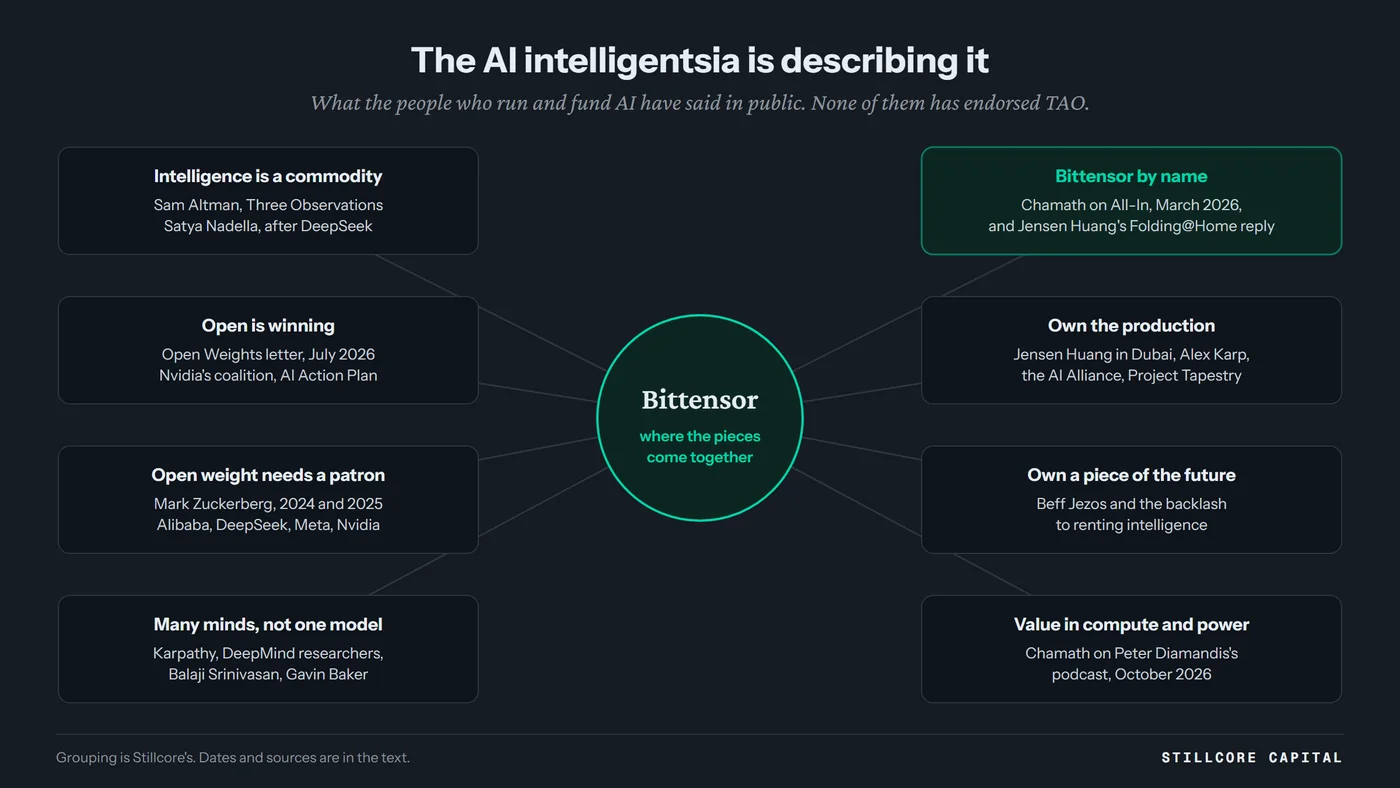
Read together, these statements describe one design, with intelligence cheap enough to trade as a commodity, research done by many agents instead of one lab, open models whose next version doesn't depend on a patron, production a country can own rather than rent, and tokens that stand for access to the capacity behind it all. Apart from that exchange at GTC, none of them has tied any of it to Bittensor. On Bittensor the first four pieces already run, with a market attached, and Gamma is set to add the fifth.
8. The Gap Is Closing
If all of this is right, why is TAO worth only about $2.5 billion, even after a halving cut its new supply in half? We see three reasons for the gap between what the network does and what it's worth, all of them temporary. The first is that revenue is still small next to issuance. SubConnect's $70 million covers less than a quarter of the roughly $300 million of new TAO the network issues each year at today's price, so new tokens still pay for most of the work.
The leading AI labs looked the same at this stage. Anthropic's IPO filing shows an operating loss of $8.1 billion on $4.6 billion of revenue in 2025. In the first half of 2026 its revenue grew fourteenfold from a year earlier and the loss narrowed to $693 million, and in the second quarter it swung to an operating profit of $974 million on $11.6 billion of revenue. Figures reported by The Information show OpenAI losing about $1.22 on operations for every dollar of its $5.7 billion of first-quarter revenue, even before counting the stock it pays employees. The labs fund that gap with investors' money, while Bittensor funds it with new tokens on a schedule that halves at fixed supply milestones, and subnet revenue roughly doubled between late summer and November.
The second is that much of TAO is still held by traders who treat it as a more volatile bet on Bitcoin, so its price follows Bitcoin's cycle more than anything the network does. The third is that the routes for outside capital are only now opening. Kraken has built native support for subnet tokens and named the first ones it'll list, bridges have carried TAO to other blockchains, and Grayscale's application to turn its Bittensor trust into an exchange-traded fund is still pending.
We've seen this setup before. At the end of 2016, Ethereum was a working platform with real developers, a handful of early applications, and a token at about $8 that most of the market ignored, and a year later it was about $750. We believe it's late 2016 again, and this time the asset is TAO. We also believe subnet revenue reaches an annual rate of $100 million by the end of 2026 and $1 billion by the end of 2027 as registration opens up and more subnets sell to outside customers, which would carry it well past today's issuance. By then we expect 256 or even 512 subnets. Gamma adds a second channel on top of that revenue, for buyers without accounts, agents above all, who pay by burning a subnet's token through a wallet key.
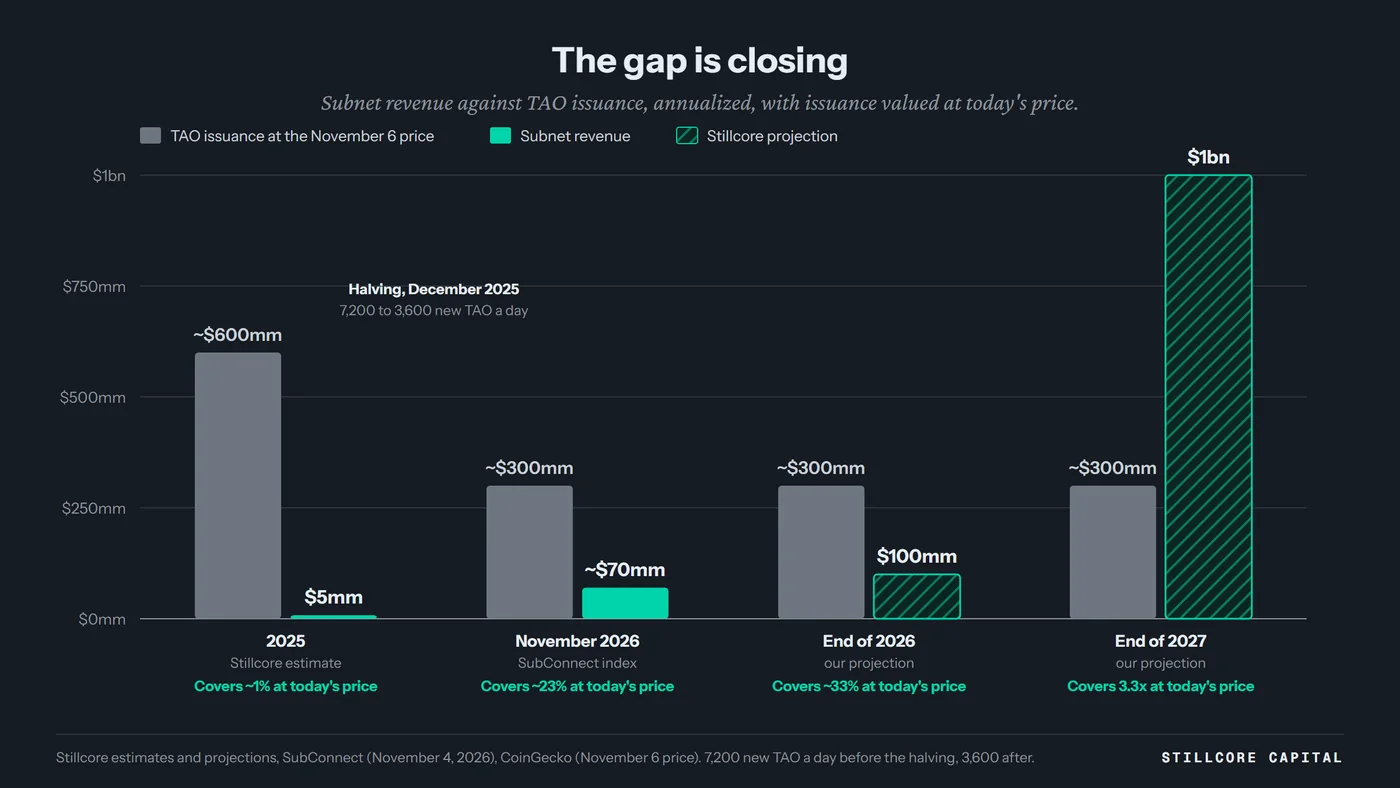
A thesis should be testable, and each of these can be measured. We're watching for five things, starting with more models built across several subnets, the clearest sign the pipelines compound, then Gamma burns growing month over month once it's live, paying-customer revenue closing on issuance, more subnets with paying customers than the two dozen or so counted this fall, and regulated access to TAO in the United States.
9. Before the Heights Are Priced
Manidis and Roberts end with a warning that investors "will find false security in owning the last era's Commanding Heights and financing this era's inventions," and that only rebuilt portfolios will have a chance at laying claim to the new ones "while they can still be purchased." They point to this era's versions of DoubleClick and Android, and we believe the largest of the new heights is already trading.
For an investor, the practical question is what in an AI portfolio captures that value if open and decentralized AI wins. Most AI portfolios hold the hyperscalers, the frontier labs, and the companies built on them, which is the right position if intelligence stays centralized and an incomplete one if it doesn't, since those holdings capture little of the value created by a market no company owns. We believe every diversified AI portfolio now needs an open slice, and that TAO is the best way to hold it. If AI stays centralized, the core of the portfolio captures it, and if it opens up, the slice does.
In TAO 2030 we set out why we believe Bittensor becomes a $1 trillion ecosystem by 2030, and this fall made us more convinced. Four shocks are arriving together. The halving has cut supply, agents and paying customers are adding demand with Gamma set to add more, results near the Pareto frontier built on GPUs nobody controls are supplying proof, and the backlash against anything with an off switch is raising the cost of the alternative. We believe 2027 will be the year of AGI and recursive self-improvement, and the year of TAO and decentralized AI.
And $1 trillion may prove modest. We believe we're about to witness economic and business miracles unlike anything in history. Exponentials sound crazy until you look at them. OpenAI and Anthropic, two companies younger than the iPhone, are reportedly raising or listing at more than $2.7 trillion between them, over a thousand times TAO. Musk now talks about quadrillion-dollar fortunes and the Kardashev scale, which ranks a civilization by the energy it uses, and he puts today's world economy at less than a trillionth of what a civilization running on its star's full output could support. The singularity will compress time and move the Overton window with it, and we may see a century of technological progress in a few years.
We expect thousands of subnets in time, each a specialized intelligence that improves daily because a market pays it to, and we believe the first artificial superintelligence will be a market rather than a model. We opened with a line from the Bittensor whitepaper, that markets could help produce machine intelligence the way they produce any other commodity. That market is running now. What will the world's marketplace for intelligence be worth?
Stillcore Capital. Opinion, not advice. This piece contains no information about the performance of any Stillcore Capital fund and is not an offer to sell or a solicitation of an offer to buy any security, fund interest or token. Projections are our estimates and may not occur, and historical price comparisons are illustrative rather than forecasts. Market data from CoinGecko as of November 6, 2026, with TAO's supply as of November 9. Bitcoin supply and price history from Blockchain.com. Stillcore and its principals hold TAO and subnet tokens, including tokens of subnets named here, and may buy or sell them at any time. Our partner Jason Calacanis co-hosts the All-In podcast. With thanks to 90 Days Liquidity, whose essay The Last Moat informed this piece. The Commanding Heights is at commanding-heights.com and worth reading in full.