Introduction
Every major technology shift starts centralized, then breaks open.
The internet followed this trajectory with remarkable fidelity. It started as ARPANET, a closed government network. It evolved through AOL, CompuServe, and Prodigy: walled gardens that controlled content, access, and monetization. By 2000, those walled gardens were dead or dying, and the open web had won. TCP/IP, HTTP, and HTML became the standards on which everything else was built. No one owns them. Everyone uses them.
AI is following the same pattern. Today, a handful of well-funded labs control the frontier: OpenAI, Google DeepMind, Anthropic, Meta AI, xAI. They have the capital, the talent, and the infrastructure. But they are the AOL of AI, not the TCP/IP. History suggests that open protocols will eventually absorb the value that closed platforms accumulate.
This document presents a foundational thesis on Bittensor and its native token, TAO. The structural case suggests that Bittensor represents the most significant opportunity in cryptocurrency since Ethereum.
The thesis rests on a simple observation. Cryptocurrency and artificial intelligence, two of the most important technological transformations of this era, are converging. Bittensor sits squarely at their intersection. Crypto promised coordination without extraction and it has largely failed to deliver. AI is transforming every sector of the economy, yet the transformation is rapidly centralizing into a handful of well-funded labs. Bittensor offers a structural solution to both problems at once.
The structural case for Bittensor's significance arguably exceeds the case that existed for Ethereum at a comparable stage. Ethereum decentralized finance, creating a multi-hundred-billion-dollar ecosystem of stablecoins, lending protocols, and decentralized exchanges. But the total addressable market of decentralized AI dwarfs decentralized finance. AI is not just a sector. It is an economic transformation that will touch every industry, every company, and eventually every human activity on Earth. If Bittensor captures even a fraction of AI's economic impact, the opportunity eclipses what Ethereum achieved with DeFi.
The analysis proceeds through four stages: the crypto thesis, how Bittensor works, why AI is the ideal domain for this technology, and the evidence from production systems. A thorough examination of these dynamics suggests an asymmetric risk-reward profile that, we believe, justifies concentrated exposure.
Part I: The Crypto Thesis
The Promise
Consider Uber. The company operates a coordination layer connecting drivers who have cars with riders who need transportation. Uber itself owns no vehicles and employs no drivers. Its value derives entirely from solving a coordination problem: matching supply with demand in real time, at scale. For this service, Uber extracts approximately 25 to 30% of every ride-hailing transaction, and its valuation represents the capitalized value of that extraction right.
Amazon's marketplace follows a similar pattern, coordinating millions of sellers with hundreds of millions of buyers while extracting fees and harvesting transaction data to compete against its own merchants. In both cases, the people who create actual value (the drivers, the sellers, the buyers) capture only a fraction of what they produce. The platform sits between them, extracting rents in perpetuity. The network effects that benefit users in the early days become lock-in that benefits the platform once dominance is achieved.
One of cryptocurrency's foundational insights was that this extraction is not technologically necessary. Coordination is fundamentally a software problem, and if the rules of coordination can be encoded in a protocol rather than controlled by a company, the platform layer can be reduced to its marginal cost. The network effects still exist, but they accrue to participants rather than extractors. Uber without Uber. Amazon without Amazon.
This concept, a protocol that coordinates exchange between suppliers and consumers at minimal cost, is what has been termed a minimally extractive coordinator.
A decentralized application, properly understood, is not a business in the traditional sense but rather a set of encoded rules specifying what constitutes valid participation, how contributions are measured, and how rewards are distributed. Facebook captures network effects and monetizes them through attention extraction. Uniswap captures network effects and charges fractions of a percent per swap, the minimum necessary to incentivize liquidity provision. The contrast is instructive.
Bitcoin demonstrated that this vision was achievable. When Bitcoin launched, there was no company, no employees, no president of Bitcoin. Yet people all over Earth donated electricity and CPU cycles to secure a monetary ledger. Nobody received a salary; instead, they competed for newly minted Bitcoins, and whoever contributed through the fastest hardware and most electricity won the most Bitcoin. The result was trillions of dollars in value created through coordination without platform extraction.
This was the promise: minimally extractive coordination at internet scale, with protocols that capture network effects without extracting rents.
Why Tokens Matter
Achieving this vision requires solving a specific problem. Understanding why native tokens are necessary, not merely useful, requires understanding the bootstrap problem every decentralized network faces and why no alternative solves it.
The challenge is a circular dependency: users will not pay for an insecure or underdeveloped network, but operators will not invest in securing or developing a network without revenue. Traditional capital solves this through debt or equity. A company raises money, builds infrastructure, and hopes to generate sufficient returns before the capital runs out. But this solution contains a structural tension when applied to networks that derive their value from not being controlled by any single entity. A decentralized protocol should operate at marginal cost indefinitely, yet external capital obligations reintroduce the very extraction that decentralization was supposed to eliminate.
Native tokens solve the bootstrap without reintroducing extraction. Rather than raising external capital that demands returns, the protocol continuously mints new tokens and distributes them to participants who contribute work: miners producing outputs, validators evaluating quality, liquidity providers enabling exchange. These early participants receive tokens as compensation for building out the supply side before organic demand materializes. If the network ultimately succeeds, the tokens earned by early contributors become valuable retroactively. The bootstrap was effectively funded by the future value of the network itself.
The mechanism is elegant but contains a dependency that explains why most token projects fail: the tokens must actually accrue value as the network succeeds. If participants can capture the benefits of the network without holding or using the token, the bootstrap mechanism fails entirely. The subsidies become worthless and the network never reaches self-sustaining operation. It is not enough to have a token; the token must be necessary for participation in ways that create durable demand.
The most robust designs combine multiple demand mechanisms. Payment utility alone is insufficient; if miners immediately sell tokens to cover costs, velocity prevents value accumulation. Staking locks tokens for network participation, reducing supply while aligning long-term incentives. Cash flows through burns or buybacks return value to holders. Governance rights create option value over the network's future direction. The tokens that work are the ones that give holders reasons to keep them rather than sell them.
Even Bitcoin and Ethereum, for all their success, face a structural limitation: they each coordinate only one thing. Bitcoin coordinates SHA-256 hashing to secure a monetary ledger. Ethereum coordinates general computation to execute smart contracts. If those problems become less important or competitors solve them better, the tokens' value propositions degrade. Neither protocol has a mechanism to adapt its focus or spawn new coordination problems as opportunities emerge.
This limitation matters because the most valuable coordination problems are not static. The problems worth solving in 2009 are not identical to those worth solving today, and neither set will match the problems of the next decade. A protocol locked to a single coordination problem is a protocol with a ceiling on its relevance. TAO is the first token to combine all four demand mechanisms while coordinating an unlimited number of problems.
The blockchain isn't an aesthetic choice. It's the only architecture that solves all of these problems at once. Bitcoin proved it could work for money. The question was whether it could work for intelligence.
The Failure
Rather than building mechanisms that could coordinate multiple types of resources or spawn new coordination problems as they emerge, the cryptocurrency industry took a different path.
The ecosystem produced an endless series of variations on a single theme: blockchains that are slightly faster, slightly cheaper, or slightly more scalable than existing ones. Ethereum begat Solana begat Avalanche begat Aptos begat Sui begat dozens of others, each promising marginal improvements in throughput or finality while competing for the same pool of decentralized applications. The industry now has more blockspace than demand requires. It is a commodity whose supply has expanded faster than usage, fragmenting liquidity and attention across ecosystems.
Network effects, supposedly the moat that would make early winners unassailable, have proven remarkably shallow in practice. A decentralized application can migrate to a Layer 2, deploy across multiple chains simultaneously, or bridge liquidity between ecosystems with relative ease. The switching costs that lock users into traditional platforms barely exist here. This is arguably good for users but devastating for the investment thesis behind most tokens: if network effects do not compound, what exactly are holders paying for?
Meanwhile, the financing structures that cryptocurrency was supposed to render obsolete have simply been replicated with different labels. Venture capitalists who once extracted equity now extract tokens, often at valuations that imply retail investors are exit liquidity rather than participants. The "low float, high FDV" launch pattern (projects releasing small percentages of tokens at launch while insiders hold the majority) became endemic. The term "rug pull" entered the lexicon because so many development teams abandoned projects after extracting value, leaving holders with worthless tokens and no recourse.
Even Bitcoin maximalists' most persistent criticism contains a kernel of truth: most tokens do not need to exist. They fail the essential test articulated above. They do not solve coordination problems that could not be solved otherwise, and they do not create structural demand that makes the token necessary. They exist primarily to create tradeable assets from which founders and early investors can extract value, which is precisely the dynamic cryptocurrency was supposed to eliminate.
The result is an industry in a crisis of purpose. Recent cycles have been dominated by meme coins, a tacit admission that the industry has run out of credible stories about technological transformation.
What the industry never produced was a protocol that solved the actual foundational problem it claimed to be solving: decentralized capital formation. If a team can design an incentive mechanism, one that specifies what work needs to be done and how to tell good work from bad, the protocol funds it. Continuously, through emissions, with miners competing to do the work and validators scoring the output. No token sale. No whitepaper promising future utility. A working business whose capital comes from the network itself and whose quality is enforced by competition.
That is what Bittensor built.
Part II: The Protocol
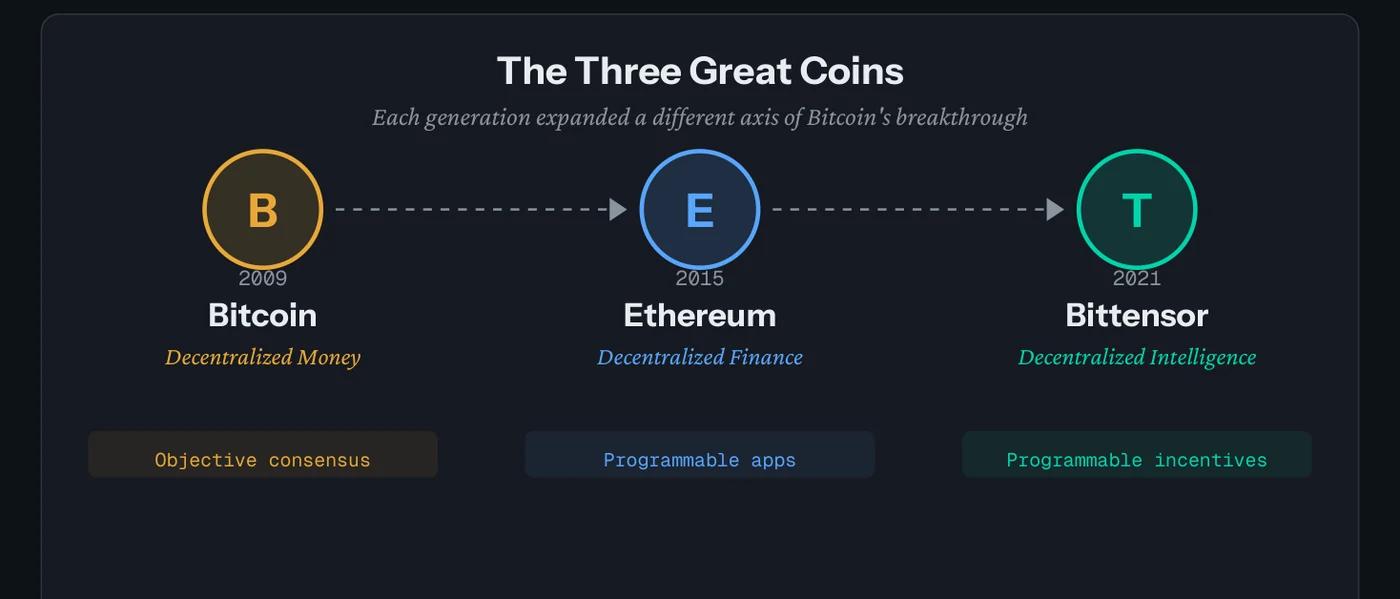
Bitcoin is decentralized money, the first great coin. Ethereum evolved this into programmable money and decentralized finance. But notice that Ethereum expanded Bitcoin in only one direction: it took Bitcoin's smart contract side and made that programmable, leading to stablecoins, decentralized lending, and decentralized exchanges.
Bittensor expands the other side of Bitcoin. It takes Bitcoin's incentive alignment engine, the mining and the token issuance, and makes that programmable. The discovery is that once you do this, you can mine for all kinds of things. Including intelligence.
Rather than building another application on top of existing infrastructure, Bittensor abstracts the bootstrap mechanism itself. It creates a protocol that spawns, funds, and governs an unlimited number of specialized minimally extractive coordinators, each addressing a distinct coordination problem, through market signals rather than committee decisions. This directly addresses the single-coordination limitation that constrains Bitcoin and Ethereum.
An analogy helps. Just as the internet in the mid-1990s became a launchpad for websites and online businesses, Bittensor serves as a launchpad for AI startups. It is a network of hundreds, soon thousands, of specialized AI models and protocols, built by developers from around the world. To quote Barry Sillbert, Bittensor is building a “World Wide Web of intelligence.”
Bittensor has miners too, but instead of solving math puzzles like Bitcoin, these miners use GPUs to solve real AI problems: predictions, modeling, research, discovery, and dozens of others. The best miners are rewarded with TAO, just like the best Bitcoin miners are rewarded with BTC. But the work these miners do is useful. It produces intelligence, not just security.
Achieving this required a fundamental technical breakthrough.
Yuma Consensus
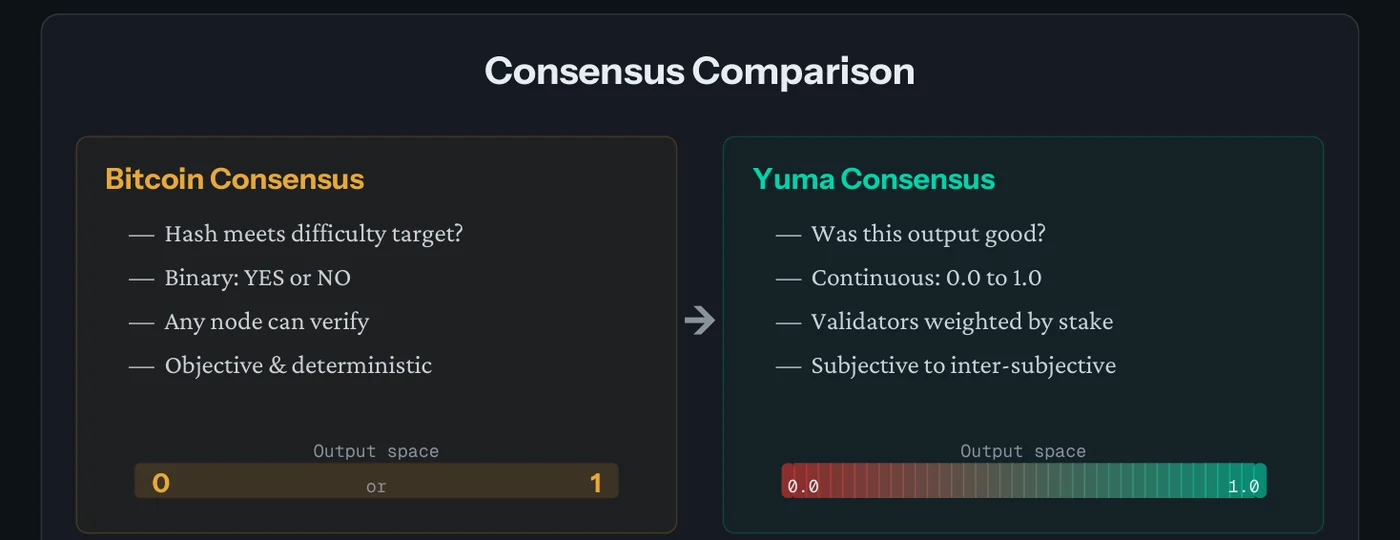
Bitcoin's consensus mechanism is elegant in its simplicity: miners compete to find hashes meeting a difficulty target, and the hash either meets the target or it does not. Any node can verify the result instantly. Binary validation means no ambiguity to exploit and no subjectivity to game.
But this simplicity is also a limitation. Many valuable coordination problems cannot be reduced to binary validation. Machine learning is a case in point. Was this model's response good? Which of two images was generated by the superior model? These questions have answers, but the answers exist on gradients, depend on context, and require judgment. They are not binary.
The challenge of extending Bitcoin's coordination mechanism to machine learning occupied Bittensor's founders for years. Machine learning outputs are high-dimensional (tensors containing millions of floating-point numbers), probabilistic (no single "correct" answer for most tasks), and subjective (quality depends on use case and context). How does one reach decentralized consensus on something inherently fuzzy?
The breakthrough came from recognizing that while individual quality judgments are subjective, patterns of agreement among judges are objective and measurable. If a diverse set of evaluators independently conclude that output A is better than output B, that consensus signal contains real information, even if no individual judgment can be proven "correct" in an absolute sense.
Yuma Consensus implements this insight through several mechanisms working in concert. Validators submit scores on a continuous gradient from zero to one rather than making binary determinations, allowing them to express degrees of confidence. Scores that deviate substantially from the emerging consensus are mathematically clipped, preventing outliers from distorting the aggregate whether through error, malice, or strategic gaming.
Validators with more TAO delegated to them carry greater weight in the consensus calculation, creating a market for validator reputation where accurate judges attract more stake over time. Validators are themselves judged by the protocol: those whose judgments consistently diverge from consensus earn less, creating strong economic pressure toward honest evaluation.
Bitcoin proved that decentralized consensus on objective facts was possible. Yuma Consensus proves that decentralized consensus on subjective quality is equally achievable, opening an entirely new category of coordination problems to cryptoeconomic mechanisms. The market provides the ultimate check: a validator that consistently rewards inferior outputs will stake on subnets that underperform, losing capital to validators with better judgment. The consensus mechanism does not merely aggregate opinions. It subjects those opinions to economic selection pressure.
Bittensor Subnets
With Yuma Consensus providing the mechanism for evaluating subjective outputs, the question became how to structure the network. The founders envisioned a system where anyone could define a coordination problem and compete for resources to solve it. Not a single network with a single purpose, but a meta-network that could spawn unlimited specialized networks.
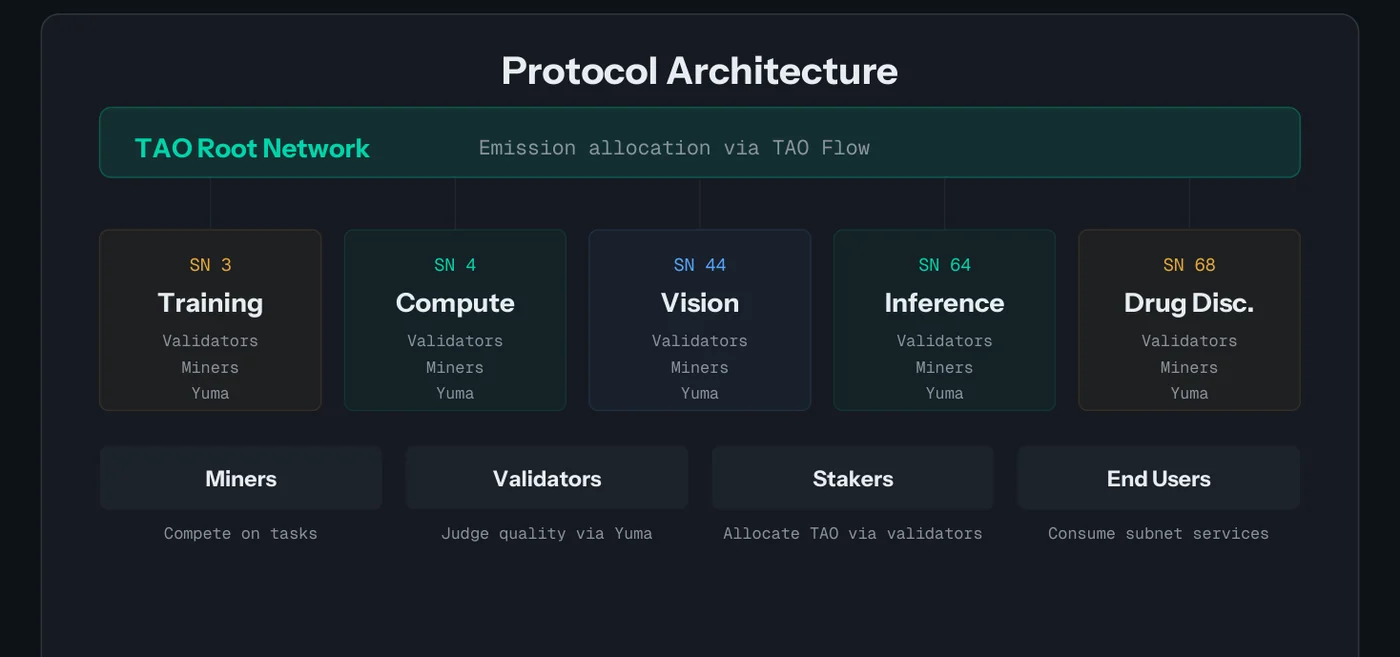
The result is the subnet architecture. Within Bittensor, there are currently over one hundred mining contests called subnets, and each functions as a standalone minimally extractive coordinator with its own problem definition and incentive mechanism.
Each subnet has an owner (sometimes a company, sometimes an individual) who defines what the subnet is mining for and how the contest works. The subnet owner specifies the task miners should perform and how validators should score outputs. Miners compete to produce the best work according to those criteria. Validators evaluate outputs using Yuma Consensus. And a native “alpha token” coordinates economic participation within the subnet.
Critically, the chain pays miners, not the subnet owner. In other words, subnets receive continuous work funded primarily by protocol emissions, with subnet owners paying only a registration cost rather than raising external capital. This mirrors exactly how Bitcoin operates. The task was "find the hash of the previous block." Miners competed. Winners got paid newly minted coins. Bitcoin, in effect, started the world's first subnet.
Within any given subnet only the best miners get paid (sometimes winner-takes-all). At historical highs, daily miner earnings on high-emission subnets have reached six figures, though rewards vary considerably with token price and competitive intensity. There is no hiding, no coasting on past performance. Every day is a new contest.
For subnet owners, the value proposition is clear: no employee recruiting, no geographic limitations, no invoices or salaries to manage. The best minds and GPUs on the planet compete on your task, and only miners who produce get paid anything. For miners, the proposition is equally compelling: work independently from anywhere on Earth, receive immediate payment from the chain, and earn ownership in the subnet via alpha tokens.
If an entrepreneur wants to start an AI company today, the conventional path requires raising tens of millions and hiring aggressively. The alternative is to start a subnet and receive work funded by the protocol.
TAO as the Coordinator of Coordinators
If each subnet is a minimally extractive coordinator solving a specific problem, what is TAO? TAO is the coordinator that coordinates the subnets themselves.
The Bittensor chain continuously mints new TAO tokens. These emissions must be distributed somehow. With over one hundred subnets competing for emissions and new subnets seeking to launch, the protocol must decide where to direct resources. The subnets that receive more emissions can pay their miners more, attracting better talent and producing better outputs. The subnets that receive fewer emissions struggle to compete. Capital allocation at this level determines which coordination problems get solved.
Early Bittensor handled emission allocation through governance, with large stakeholders voting on which subnets should receive what share. This approach worked to bootstrap the system but could not scale. It concentrated discretionary control over billions in capital allocation within a small group, reintroducing the committee-based decision-making that decentralization was supposed to eliminate.
Dynamic TAO (dTAO) and TAO Flow
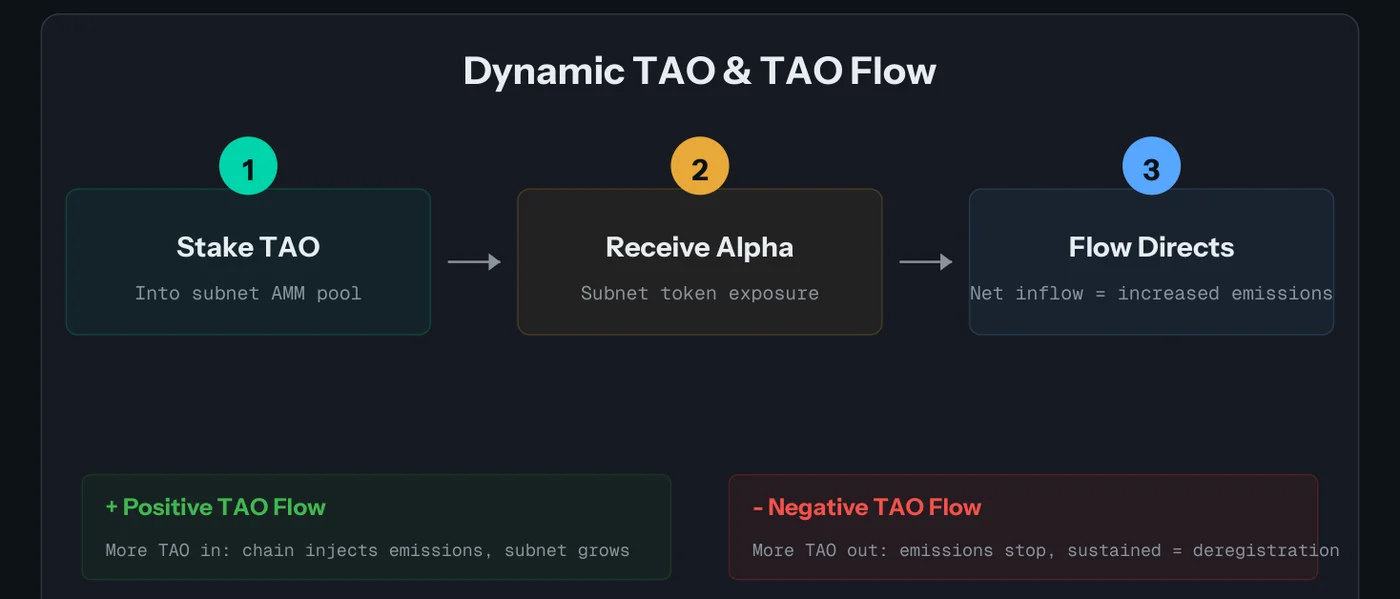
The solution was to replace human judgment with market signals. Dynamic TAO introduced a mechanism that changed the protocol's economics: each subnet now has an automated market maker (AMM), essentially a built-in exchange, pairing its alpha token with TAO. This exchange is not an application built on top of Bittensor. It is the chain itself. The protocol provides liquidity.
To gain exposure to a subnet, participants stake TAO into its pool and receive alpha tokens in return. The price of each subnet token, and thus the subnet's market cap, is determined by the ratio of TAO to alpha tokens in the pool. There is no other way to get subnet tokens; every buyer must go through the TAO-denominated AMM.
The original Dynamic TAO mechanism allocated emissions based on subnet market cap: the higher a subnet's price, the larger its share of newly minted TAO. The flaw was structural. Once a subnet reached a high valuation, it kept collecting outsized emissions regardless of whether anyone was still actively buying. Incumbents were rewarded for having arrived early, not for continuing to deliver. The mechanism measured wealth, not demand.
TAO Flow corrected this by making current buying pressure the signal rather than accumulated price. The protocol now observes how much TAO is flowing into each subnet's liquidity pool in real time. Subnets attracting net positive inflows receive a larger share of the roughly 3,600 TAO minted daily. The question the protocol asks is simple: which subnet has the most current demand? That is where emissions go.
The consequences of losing demand are severe. If a subnet experiences net negative TAO Flow (more TAO leaving the pool than entering it), the chain stops injecting new TAO and new alpha tokens into that subnet's pool. Miners, validators, and the subnet owner still receive newly emitted alpha tokens, but with no fresh TAO backing them, the result is dilution. The penalty for losing market interest is not a smaller reward. It is the erosion of the value underneath the rewards that remain.
Sustained negative flow triggers deregistration: the subnet loses its slot entirely, which is reclaimed for a new entrant. A subnet cannot coast on past performance. The evaluation is continuous, and the protocol is indifferent to history.
The Calculation Problem
With this mechanism understood, it becomes possible to appreciate what Bittensor actually solves: the calculation problem for resource allocation.
A centralized technology company faces an allocation problem it can never fully solve. Which products should it build? Which capabilities should it prioritize? Should it spend billions on one massive initiative or spread resources across ten smaller ones? How does it know? In practice, it guesses, using lagging user feedback, biased executive intuition, and artificial internal metrics. What it lacks is market prices that aggregate distributed knowledge about what is actually valuable.
Bittensor's subnet prices solve this in real time. A subnet with high market cap and positive TAO flow is the market saying "this service is valuable, deploy resources here." A failing subnet approaching deregistration is the market saying "shut it down." The protocol observes these signals and allocates capital accordingly, continuously, permissionlessly, and at global scale.
The analogy to venture capital is instructive. Y Combinator processes applications on human timescales, makes judgment calls subject to bias, and can only fund so many companies per year. Bittensor runs this process every block, for every subnet, with capital allocation determined by aggregated market intelligence rather than partner meetings.
A Virtuous Cycle: Value Capture and the Bittensor Flywheel
TAO emissions effectively seed an ecosystem of AI startups through continuous, market-directed capital allocation. But this raises an obvious question: emissions fund development, so how does value flow back to TAO holders? If tokens are continuously printed and distributed to miners, what prevents perpetual dilution?
TAO functions, in effect, as an index of the entire Bittensor ecosystem. Holding a specific subnet token captures more upside if that particular subnet wins, but TAO captures value regardless of which subnets win. It acts akin to an index tracking the S&P 500 of decentralized AI, and the only way to access these startups is by holding TAO.
The architecture creates structural demand through mechanisms that cannot be circumvented. TAO serves as the exclusive medium of exchange for all subnet tokens. Every subnet token must trade against TAO in an AMM pool with liquidity provided by the chain itself. Every dollar of value created anywhere in the ecosystem requires TAO to access.
Subnets generate cash flows through their products (inference APIs, compute marketplaces, agent platforms), and leading subnets implement buybacks, using revenue to purchase their own alpha tokens. Because all subnet tokens pair with TAO, subnet token demand mechanically creates TAO demand. Revenue flows up through the liquidity architecture regardless of which particular applications succeed.
TAO staked into subnet pools earns alpha emissions while simultaneously removing supply from circulation. The more TAO staked across subnets, the less available for sale, creating structural supply reduction that compounds as the ecosystem grows. Governance occurs through staking itself: where participants stake is continuous market-based governance, directing emissions to subnets believed to create value.
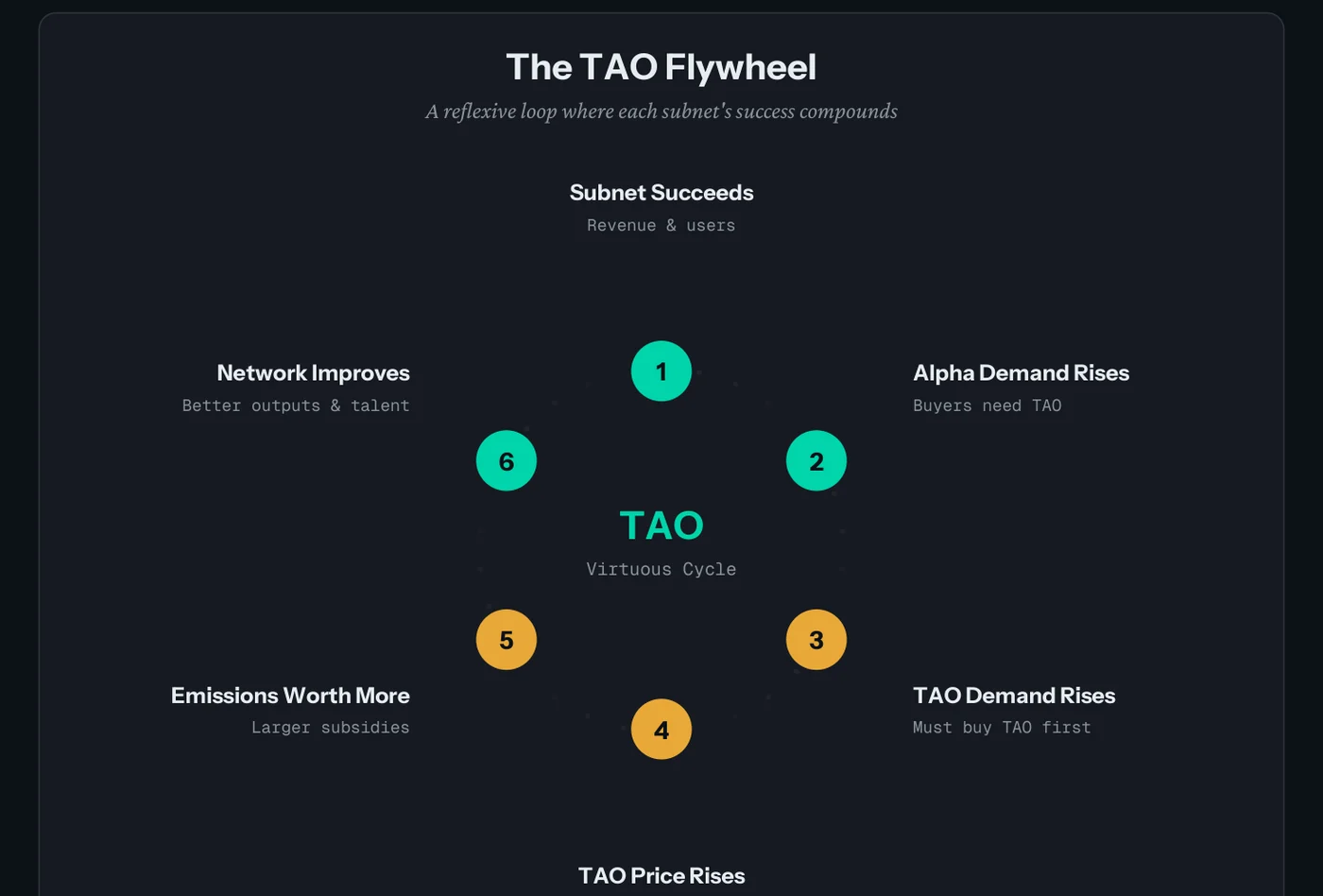
When a subnet succeeds (generating revenue, attracting users, producing valuable outputs), demand for its alpha token increases. Every buyer of alpha must purchase TAO first. TAO appreciation then lifts all subnet valuations, since alpha tokens are priced in TAO, and increases the dollar value of emissions for all subnets. The dynamic is positive-sum: every subnet's success benefits every other subnet.
The reflexive loop is what makes this compound. As revenue accumulates, alpha token prices rise; as alpha tokens rise, TAO rises with them, since all alpha trades against TAO. Higher TAO prices increase the dollar value of emissions network-wide, meaning larger subsidies to attract even more capable participants. More participants build more products. More products generate more revenue. The cycle reinforces itself.
The compound nature of these dynamics means that value accrual tends to be front-loaded for early participants, as flywheel effects are typically recognized only after they have begun compounding.
The Moat: Bittensor's Network Effects
As noted earlier, network effects in cryptocurrency have proven remarkably shallow. Ethereum was supposed to be the dominant smart contract platform forever; Solana, Avalanche, and others took significant share anyway. Applications migrate. Liquidity bridges. Users follow incentives.
Bittensor's network effects are structurally different, and understanding why requires examining what actually locks participants into the ecosystem.
A founder evaluating where to launch an open-source AI protocol faces an asymmetric choice. Choosing Bittensor means immediate access to established mining pools staffed by proven talent with track records of performance. It means validators who have built reputations over years of honest evaluation, deep liquidity in the enshrined DEX where the protocol itself provides the other side of every trade, and composability with existing subnets that can cut inference costs to a fraction of centralized rates. It means alpha tokens that give miners ownership stake, aligning their long-term interests with those of the subnet owner.
Launching elsewhere would require bootstrapping a mining community from scratch, recruiting talent one by one and hoping they trust untested mechanisms. It would mean standing up validator infrastructure without the reputation systems that took years to develop, providing liquidity through treasury allocation or hoping market makers appear, and paying centralized rates for compute that Bittensor subnets provide at a fraction of the cost. Miners on the alternative platform would be mercenaries, not owners.
Competing projects tend to be point solutions addressing one aspect of the coordination problem, whether GPU compute, verifiable training, or blockchain-AI infrastructure. None has replicated the full-stack economy that continuous protocol emissions sustain. None has spent the years and the billion-plus dollars in emissions required to bootstrap a comparable ecosystem from nothing. They are point solutions competing against an integrated economy.
The moat is not that Bittensor is technically impossible to replicate. The code is open source; the mechanisms are documented. What cannot be replicated is the accumulated human capital, the proven track records, the deep liquidity, and the composable infrastructure that took years and hundreds of millions of dollars in emissions to build. A new entrant would need to spend comparable resources over comparable time to reach parity, and by the time it did, Bittensor would have compounded further.
Beyond the accumulated human capital, the emissions mechanism itself constitutes a second moat. Annual emissions represent one of the largest continuous funding streams for open-source AI development in existence, a figure that scales directly with TAO's price. At previous highs, annual emissions approached a billion dollars. These are not numbers on a whitepaper. This is actual capital being deployed, every day, to contributors worldwide.
The fair launch constitutes a third. When Bittensor launched, the founders rejected the standard playbook of premining tokens or selling discounted allocations to venture capitalists. TAO was distributed entirely through mining from day one. Everyone who received tokens had to contribute work to get them. This choice had real costs (slower initial development, less marketing reach, lower early liquidity) but it produced something that cannot be reverse-engineered: a holder base of builders rather than speculators. Like Bitcoin, TAO has a fixed supply of 21 million tokens and a halving schedule that progressively reduces new issuance. Unlike projects where large insider allocations create known future selling pressure, TAO's distribution came through work. The community that formed around Bittensor consists disproportionately of builders and contributors rather than passive investors waiting for liquidity events.
This matters for the moat because a fair launch cannot be replicated after the fact. It only works when a project begins quietly and allows supply, community, and price to form organically over time. A potential competitor faces a structural catch-22: fork the code and you need billions to fund comparable emissions, but venture capital backing destroys fair-launch credibility by reintroducing insider allocations. Build a centralized alternative and you are fighting the combined output of over a hundred specialized subnets staffed by thousands of contributors with unlimited upside. The evidence suggests that top AI talent has recognized this calculus: they are joining Bittensor as miners and subnet operators rather than starting competitors.
The contrast with Layer 1 blockchain competition is instructive. When Solana launched, an Ethereum dApp could migrate by redeploying contracts. Users followed because they wanted cheap transactions. In Bittensor, the users are the miners, validators, and subnet operators, all of whom have built specific capital on this specific network. Reputations cannot be redeployed. Track records cannot be bridged. A community of competing AI researchers who have spent years learning to beat each other cannot be forked.
This is the fundamental distinction between Bittensor and other cryptocurrency networks. In Ethereum or Solana, the product is blockspace; the token is merely the medium of payment. In Bittensor, TAO is the sum of all the intelligence being produced by miners, the revenue generated by subnet products and services, the compute aggregated across the network, the human capital accumulated over years of competition. It is both the index that captures this value and the engine that fuels it: emissions are the subsidy that attracts participants, funds development, and coordinates the entire ecosystem. The system is architected to drive value back to the token, thereby increasing the value of the subsidy, which increases the value and usefulness of the network. The token is not incidental to the product. The token is the product.
Part III: The AI Thesis
Bittensor was purpose-built for AI coordination. But why AI specifically? Because AI is the largest coordination problem in the economy, and if it centralizes into an extractive monopoly, the consequences will be measured in decades.
AI's Transformation of the Economy
Artificial intelligence is not a technology sector. It is a general-purpose economic transformation that will reshape every industry it touches. The question is not whether AI will be important, but who will control it and how the value it creates will be distributed.
The scale of investment reflects this reality. Hundreds of billions of dollars are flowing into AI infrastructure annually. Technology companies are spending more on AI compute than they spent building the original internet. The major cloud providers are racing to deploy millions of GPUs. New data centers are consuming gigawatts of power.
Every sector will be affected: software development transformed by AI coding assistants, customer service shifting to AI agents, legal and financial services deploying AI for document analysis and research, healthcare using AI for diagnostics and drug discovery, creative industries grappling with generative AI, and manufacturing integrating AI for quality control and predictive maintenance.
And this is before the physical-world transformations now becoming visible on the horizon. Self-driving vehicles will restructure transportation and logistics. Humanoid robots are moving from research labs to pilot deployments in warehouses and factories. The integration of AI into the physical economy through autonomous vehicles and robotics will dwarf the impact of AI on software and services alone.
AI progress is not linear. It compounds across four simultaneous curves. Compute hardware delivers orders-of-magnitude improvement per generation. The volume of training data, both organic and synthetic, grows continuously. Algorithmic innovation (transformers, diffusion models, reasoning systems) has accelerated since 2017. And open-source collaboration through platforms like Hugging Face allows millions of developers to iterate faster than any single organization. Any one of these curves would be significant. All four are converging.
The Centralization Problem
As AI capabilities expand, so does concentration. Today, the frontier of AI development is controlled by a small number of well-funded labs: OpenAI, Anthropic, Google DeepMind, Meta AI, xAI, and a handful of others. These organizations have the capital to train massive models, the talent to push capabilities forward, and the infrastructure to deploy at scale. The barriers to entry are enormous and growing.
Training a frontier model requires hundreds of millions of dollars in compute alone. Access to training data has become a competitive moat. The top AI researchers command compensation packages that only the best-funded organizations can afford. Each generation of models raises the stakes higher, making it increasingly difficult for new entrants to compete.
This concentration raises several concerns. It reintroduces the extraction dynamic that platform monopolies established: a small number of companies controlling critical infrastructure and extracting rents from everyone who depends on it. It creates single points of failure and control. And it risks slowing innovation by channeling development through corporate bureaucracies rather than distributed experimentation.
The geopolitical dimension compounds these concerns. AI is increasingly understood as strategic infrastructure. Nations recognize that dependence on foreign-controlled AI creates vulnerabilities. China cannot rely on American AI infrastructure for sensitive applications. Europe is concerned about sovereignty over critical technology. Smaller nations face the prospect of permanent dependence on AI systems they neither control nor fully understand.
The Case for Decentralized AI
For the past several decades, open source has repeatedly demonstrated its superiority for infrastructure technology. TCP/IP, Linux, Python, PyTorch: some of humanity's most important technological infrastructure emerged from open collaboration rather than corporate development.
Every layer of the digital economy eventually commoditizes into open-source infrastructure. This is not ideological preference. It is economic inevitability. Proprietary networks lost to open protocols. Proprietary operating systems lost to Linux. Proprietary mobile platforms lost to Android. In each case, the pattern was the same: the closed system dominated early when integration mattered most, then open alternatives caught up on quality and won on cost, flexibility, and ecosystem breadth. No single company, no matter how well capitalized, can outproduce the entire world.
The pattern repeats because open systems have structural advantages that closed systems cannot match. They attract talent from everywhere, not just from one company's hiring pipeline. They iterate faster because thousands of developers can experiment simultaneously. They build trust because the code is auditable. They survive corporate strategy shifts because no single entity controls them.
We believe AI will follow the same trajectory. The closed labs have billions in capital. The open-source community has millions of developers. History shows who wins when capital faces scale.
This is no longer a theoretical claim. In 2025, Chinese laboratories proved it empirically. DeepSeek, Kimi, and others released frontier-class open-source models that matched or exceeded the performance of closed Western labs at a fraction of the training cost. These releases were strategically motivated (a response to U.S. export controls that cap China's access to leading-edge chips) but the lesson they delivered is permanent: frontier intelligence has no structural moat. Intelligence can, and will, be distilled. It ultimately commoditizes on cost, and open-source wins that fight every time.
The current wave of Chinese-subsidized model releases will not last forever. Export controls constrain their compute ceiling. Geopolitical trust limits enterprise adoption. And the capital behind these releases eventually needs a return. But the damage to the closed-lab thesis is done. If intelligence is a commodity, value shifts from those who produce it to those who can most efficiently coordinate, serve, and monetize it. The question is no longer whether open-source wins. The question is who captures the value when it does.
Open-source wins, but its contributors historically have not. Linux generated billions in value; the kernel developers captured almost none of it. PyTorch powers the AI revolution; its creators are salaried employees at Meta. The pattern is consistent: open-source infrastructure absorbs the market, and the value flows to the companies that commercialize it rather than the people who built it. Corporate-sponsored open-source addresses this partially but reintroduces dependencies on corporate priorities and resources.
Bittensor offers a structural solution. The token mechanism that solves the bootstrap problem for networks can also solve the value capture problem for open-source development. Contributors receive tokens proportional to their contribution value, and if the network succeeds, those tokens appreciate. This aligns incentives without requiring corporate employment or hoping for downstream acquisition. TAO is that token for open-source AI.
Why Bittensor Is Uniquely Positioned
Bittensor is not simply a blockchain that happens to focus on AI. It is an economic system purpose-built to coordinate the development of decentralized intelligence at global scale. More specifically, it is purpose-built for the world the Chinese labs just proved we live in: one where intelligence is abundant and commoditizing, and the value accrues to whoever can coordinate and serve it most efficiently.
TAO coordinates thousands of AI developers and researchers contributing to over one hundred specialized subnets, competing to solve problems ranging from inference to coding to drug discovery. Millions of GPU-hours flow through the network. Tens of thousands of nodes provide compute. Annual emissions at current prices represent hundreds of millions of dollars flowing to fund this activity (approaching a billion at previous highs). This is a continuous, permissionless stream of capital directed by market signals to the most promising developments.
Each subnet is effectively a startup that anyone can join by contributing work or capital. The protocol handles funding through emissions. The market handles capital allocation through TAO Flow. The competitive mechanism handles quality control through winner-take-all dynamics. What emerges is a distributed R&D lab operating at global scale, with economic incentives aligned from individual miners up through subnet owners to TAO holders.
The relationship between Bittensor and open-source model releases is symbiotic and immediate. When DeepSeek or Kimi release a new frontier model, Bittensor's subnets absorb it on day one. Chutes served both on release. Ridges builds coding agents on top of them. The Chinese labs bear the training cost; Bittensor captures the value downstream through inference, fine-tuning, and application. Every open-source model released anywhere in the world makes Bittensor's subnets better instantly. And eventually, subnets like Templar, which produced the largest model ever trained in a decentralized fashion, develop the capacity to produce competitive base models independently, providing a backstop for when external subsidies dry up.
Iteration speed is paramount in AI development. Within Bittensor's subnets, competitive pressure is constant. Reaching high performance is not a stopping point because someone will immediately push higher. Subnets have achieved in weeks what might take traditional corporate R&D months or years.
Talent aggregation represents another advantage. Credentialed AI talent is expensive, and opportunities are geographically concentrated. Bittensor allows anyone to contribute based purely on output quality: a PhD at a frontier lab, a self-taught developer in a country with limited professional opportunities, or a professional mining operation scanning for arbitrage. The best developers worldwide compete to solve posted incentives. Contribution is decoupled from credentials.
Cost structure favors decentralization. A subnet does not need to raise venture capital, hire employees, rent office space, or maintain HR departments. The protocol pays for work; the subnet owner designs the incentive mechanism. Overhead that consumes significant resources in traditional organizations simply does not exist, allowing subnets to offer services at a fraction of the cost of centralized competitors while still rewarding contributors handsomely.
Part IV: The Evidence
The preceding sections describe architecture and mechanisms. This section presents evidence that these mechanisms work in practice. Theory and mechanism design matter, but they must translate into observable results.
Production Subnets
Chutes (Subnet 64) provides serverless AI inference: developers deploy models in seconds without managing infrastructure. The platform processes over 100 billion tokens daily across more than 600,000 users, and ranks as the leading provider on OpenRouter, the largest open-source model aggregator, handling roughly a quarter of that platform's total daily volume. Revenue runs at meaningful annualized figures, which automatically converts to alpha token buybacks.
The economics explain the traction. Chutes operates a permissionless compute marketplace where thousands of GPU nodes compete for inference requests. These miners often run hardware with idle capacity, contributing compute at rates that centralized providers structurally cannot match. The result: inference on frontier open-source models at a fraction of what managed GPU workloads cost on major cloud platforms. Against specialized providers, the pricing differential is narrower, but the supply-side incentive structure is fundamentally different. VC-backed inference companies must raise capital to subsidize pricing. Chutes miners are subsidized by TAO emissions, creating a durable cost floor independent of venture funding cycles. That structural advantage is what matters for long-term positioning in an inference market projected to grow substantially through the end of the decade.
Targon (Subnet 4) occupies a similar position in decentralized AI infrastructure to Chutes with a focus on hardware-attested confidential compute at scale. The platform integrates CPU and GPU-level encryption through Trusted Execution Environments, meaning customer data remains cryptographically sealed even from the machine operators running the workload. This is not a contractual promise. It is a hardware guarantee. Among the hyperscalers, only Azure offers anything comparable for GPU workloads, limited to a single SKU in two regions. AWS and Google Cloud have no equivalent. Meanwhile, Targon is offering full-stack confidential AI compute without geographic or hardware constraints.
The production evidence supports that thesis. Dippy AI, a consumer AI companion app with millions of downloads, routes over 20 billion paid inference tokens per day through Targon after migrating from a well-funded centralized competitor. A real company switched from centralized to decentralized compute for production workloads, the kind of migration that validates pricing, reliability, and trust simultaneously. Within the Bittensor ecosystem, other subnets are adopting Targon's attestation framework, deepening integration with every adoption. Revenue runs at seven to eight-figure annualized levels, all committed to alpha buybacks, against a market cap that remains a fraction of less capable decentralized compute peers.
Ridges (Subnet 62) is a decentralized tournament for autonomous coding agents. Anyone can build and submit an agent. These agents compete daily against real software engineering challenges: debugging, refactoring, test writing. Top performers earn emissions. The sector context matters: AI-assisted coding is arguably the fastest-monetizing category in enterprise software history. Comparable centralized companies in the AI coding space command valuations measured in tens of billions. Ridges' agents have achieved 73.6% on SWE-Bench Verified, the standard benchmark for this category. That is the best open-source score available, closing in on the ~79% ceiling set by proprietary systems from leading AI labs.
What sustains the quality is the competitive mechanism itself. Validators continuously generate fresh challenges from real codebases. Miners deploy agents that must produce functionally correct solutions verified in sandboxed environments. A difficulty-pricing system learns from thousands of agent attempts to calibrate rewards dynamically. The result is a dataset of adversarial, market-priced coding challenges that no centralized lab can replicate, and a network of agents under constant pressure to improve. Ridges' cost-to-serve runs approximately $5 per user per month by consuming inference from other Bittensor subnets. Centralized competitors typically spend hundreds per seat. The performance gap to frontier proprietary systems is measured in single-digit percentage points. The valuation gap is measured in orders of magnitude.
Hippius (Subnet 75) solves a problem the ecosystem cannot ignore indefinitely: where the data lives. Every subnet producing or consuming AI models needs persistent storage: training sets, model weights, checkpoints, inference logs. Today, most of that data flows to AWS and Google Cloud. A decentralized intelligence network dependent on the most centralized infrastructure companies on earth is a contradiction that scales poorly. Hippius provides decentralized cloud storage that is functionally equivalent to Amazon S3, with full API compatibility so that existing applications can migrate with minimal code changes.
The pricing difference is not marginal. Storing 10 TB on S3 costs roughly $200 per month. On Hippius, the same capacity costs a few dollars. That gap reflects fundamentally different cost structures: decentralized miners operate on hardware already amortized, incentivized by emissions rather than by the margin requirements of a trillion-dollar cloud provider. The platform supports fiat payments through Stripe alongside native token payments, offers a desktop sync client, and publishes SDKs for Python and Rust. Token mechanics reinforce usage-driven demand: miners must lock tokens to operate nodes, and customer payments convert to locked tokens, tying every gigabyte stored to structural buy pressure on the alpha token.
At its current valuation, Hippius trades at a fraction of established decentralized storage protocols. None of those projects have what Hippius offers: native integration into a fast-growing AI network where storage is not an optional add-on but a dependency that deepens with every subnet that trains, stores, or serves a model. As the ecosystem's storage layer, Hippius accrues switching costs that standalone protocols cannot generate.
Templar (Subnet 3) addresses perhaps the highest-stakes question in decentralized AI: can frontier model pre-training be done outside the major labs? Training a state-of-the-art model requires concentrations of compute that only a handful of organizations can afford, and the cost roughly doubles every six to ten months. Templar is a decentralized training network where participants contribute GPUs over the public internet without permission or whitelisting. Every other project pursuing decentralized training at scale gates or curates its participants. Templar is the only one running fully open.
The reason this works at all is a gradient compression technique called SparseLoCo, which reduces the communication overhead of distributed training by approximately 97%. A 72-billion-parameter model can train across nodes connected by ordinary internet links with only 6% bandwidth overhead, a result that outperforms comparable methods from leading research labs on both loss and efficiency. Both the optimizer and Templar's reward mechanism have been peer-reviewed and accepted at the NeurIPS OPT2025 Workshop, making Templar the first Bittensor project to clear a top-tier machine learning venue. The completed 1-billion-parameter run matched centralized training quality across standard benchmarks. The current run, Covenant 72B, is the largest permissionless collaborative training effort ever attempted: 72 billion parameters, a 1.2 trillion token budget, and over 20 miners each running clusters of B200 GPUs. Early checkpoints already outperform every prior decentralized pre-training result.
The honest framing: Templar's effective throughput is roughly 300x smaller than frontier centralized datacenters. But decentralized training compute has been growing at approximately 20x per year, about four times faster than centralized infrastructure expansion. If that trajectory holds, the gap narrows materially within a few years. The team also operates subnets for compute and post-training, giving it coverage across the full model development pipeline that single-stage competitors lack. Revenue flows through training-as-a-service fees, with all proceeds directed to token buybacks. Whether Templar reaches frontier scale depends on execution, but the proof of concept (permissionless training that matches centralized quality) is already established and peer-reviewed.
Score (Subnet 44) turns Bittensor's competitive mechanism toward computer vision, one of the largest undermonetized data sources in the economy. There are billions of cameras generating footage worldwide, but converting raw video into structured intelligence remains expensive and fragmented. Traditional providers charge per API call at rates that scale linearly with volume, and specialized sports analytics firms price their services north of $100,000 per year with proprietary camera requirements. Score claims a 10 to 100x cost reduction through its Manako AI platform, which processes live video feeds into queryable datasets.
The architecture is what makes the cost structure possible. Manako runs a base vision model for standard detection and classification tasks. When it encounters edge cases (unusual lighting, rare objects, unfamiliar environments), those inputs route to Subnet 44's miner network, where participants compete to improve the model's coverage. Each customer deployment generates new edge cases; each resolved edge case makes the platform more capable; each capability gain makes the next customer easier to close. This is the Bittensor flywheel applied to a domain where most competitors improve only by hiring more engineers or buying more labeled data. Score works with existing cameras, requiring no proprietary hardware installations.
The customer base already spans multiple industries: sports analytics, petroleum stations, and vehicle wash locations. That diversity matters because it demonstrates the platform is not a single-vertical tool. No other provider offers a decentralized, continuously improving vision system that spans multiple industries at this price point. The vision AI market has no dominant horizontal platform. Score's model accuracy is already approaching the human gold standard, and it improves with every deployment.
Nova (Subnet 68) applies the Bittensor mechanism to drug discovery, a domain where the stakes dwarf anything else in the subnet ecosystem. A single approved compound can generate billions in licensing revenue. But reaching approval costs an average of $2.6 billion and takes up to a decade, with over 90% of candidates failing along the way. The core bottleneck is the earliest stage: identifying promising molecular candidates worth advancing to lab testing. Metanova, the team behind Nova, has built a system where miners compete around the clock to discover novel compounds against defined pharmaceutical targets, initially focused on psychiatric and central nervous system indications.
Two competition formats run simultaneously. One rewards miners for submitting candidate molecules with the highest binding affinity to target proteins. The other rewards miners for developing better search algorithms that explore chemical space more efficiently, creating a feedback loop where the discovery engine itself improves over time. Miners work across a library of 1.75 billion compounds, constrained to synthesizable molecules that mimic real-world chemistry. The subnet reports over 400% improvements in hit quality over baseline: not more candidates, but meaningfully better ones. And the compute cost to the Metanova team is near zero, since miners absorb it through emissions.
The centralized comparables put the opportunity in context. Companies pursuing AI-driven drug discovery through proprietary platforms with large internal teams command valuations in the billions. Nova externalizes the search to a global miner network at a fraction of the cost. The subnet is pre-revenue and early: wet-lab validation of top compounds is expected through partnerships for both small-molecule and nanobody testing. Drug discovery is genuinely hard, and the path from computational hit to approved therapeutic is long and uncertain. But the risk-reward is asymmetric in a way few other subnets can claim: a single validated lead entering licensing discussions could be worth more than the entire current Bittensor ecosystem.
It’s worth noting that all of these numbers require context. Current revenues are modest by Web2 standards. This is a trajectory bet on cost structure and competitive dynamics, not a claim that decentralized AI has already achieved scale parity with centralized alternatives. The evidence supporting that bet: products work in production with real users; cost advantages range from 6x to 400x versus centralized alternatives; growth is rapid from a zero base. The opportunity is that if revenue materializes at scale, current subnet valuations will prove to have been dramatically cheap.
Subnet Composability
The subnets do not operate in isolation. They build on each other, and the value dynamics scale faster than linear network effects would suggest.
Each new subnet does not just add its own capability to the network. It creates new possible integrations with every existing subnet. Ridges plus Chutes. Ridges plus Targon. Ridges plus Chutes plus Targon plus Hippius. The possible combinations multiply exponentially with each addition.
This plays out concretely in cost structures. When Ridges runs its SWE-Bench evaluations, it does not pay AWS or Azure for inference. It uses Chutes and Targon. The result: 500 coding challenges solved for a fraction of what it would cost on centralized infrastructure. Each layer passes through cost savings to the next.
When a subnet builds on another subnet, it pays perhaps one-sixth of the centralized cost. If that subnet then offers its own service, it can price aggressively while maintaining margins. The savings compound multiplicatively at every layer. A centralized three-layer stack costing $18 ($6 per layer) would cost approximately $3 ($1 per layer) on Bittensor, and because each layer consumes the output of layers below it, the savings compound further: the inputs themselves are already cheaper. The effective advantage grows with every dependency in the stack.
A subnet deeply integrated with the Bittensor stack would face massive cost increases if it tried to migrate to centralized infrastructure. The switching cost is not just technical integration; it is the loss of compounding cost advantages across every dependency.
Value does not accrue at one layer; it flows through every layer, all denominated in TAO, all reinforcing demand for the base asset. And as the subnet count grows, the possible combinations do not double. They explode exponentially.
The Decentralized Frontier Lab
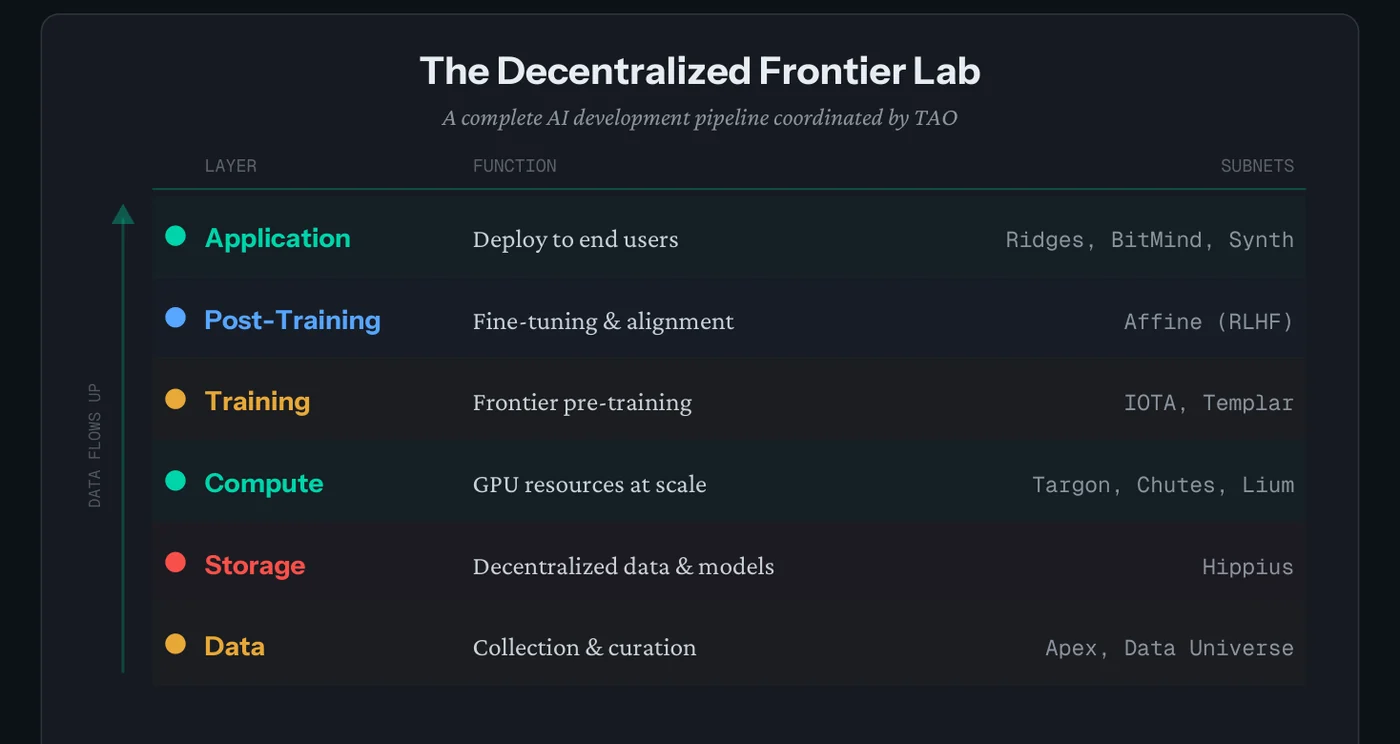
As explained, the subnets operating on Bittensor are not scattered projects pursuing unrelated goals. Together, they form a coordinated stack covering the entire AI development pipeline: a decentralized frontier lab assembled through market coordination rather than corporate planning.
The Data Layer handles collection, curation, and preparation. Subnets like Apex and Data Universe aggregate and clean the datasets that downstream models require.
The Storage Layer provides decentralized infrastructure for datasets and model weights. Hippius offers distributed storage that removes dependency on centralized cloud providers.
The Compute Layer aggregates GPU resources at scale. Targon coordinates tens of millions of dollars in NVIDIA-certified hardware. Chutes processes over a hundred billion tokens daily. Lium offers distributed GPU coordination for training workloads. Together, these subnets provide the raw computational substrate.
The Training Layer focuses on model development. IOTA pursues frontier model pre-training. Templar enables distributed pre-training across nodes, allowing training runs that no single participant could afford alone.
The Post-Training Layer refines models after initial training. Affine specializes in reinforcement learning and RLHF fine-tuning, the techniques that transform base models into useful assistants.
The Application Layer deploys capabilities to end users. Ridges runs autonomous AI coding agents. BitMind develops domain-specific models. Synth operates prediction markets.
This is a complete AI development stack. Data flows up through storage and compute into training, refinement, and application. Each layer can draw on layers below it. The result is vertical integration achieved through horizontal coordination: no single entity controls the stack, yet the stack functions as an integrated whole.
To Recap
The theoretical foundation is sound: native tokens are essential to the bootstrap mechanisms that make minimally extractive coordination economically viable, and TAO synthesizes the value accrual mechanisms at both protocol and application layers in ways that are mutually reinforcing rather than independent.
The technical innovation is substantive: Yuma Consensus enables decentralized agreement on subjective quality, opening an entirely new category of coordination problems to cryptoeconomic mechanisms that were previously inaccessible.
The application domain is well-suited: open-source artificial intelligence requires the fast iteration, global talent aggregation, and continuous competition that Bittensor's architecture provides, while centralized alternatives face structural limitations in cost, speed, and coordination.
The evidence from production systems is concrete: functioning subnets generating revenue, achieving performance competitive with frontier commercial offerings, and delivering services at a fraction of the cost of centralized alternatives.
Network effects drive integration depth that makes the ecosystem increasingly difficult to replicate, while the value capture architecture ensures that every subnet's success benefits every other subnet through TAO-denominated economics. As autonomous AI agents become the dominant paradigm for how software interacts with the world, the need for private, affordable, and sustainably funded AI infrastructure becomes not just valuable but essential. Bittensor is the only ecosystem built to serve this need.
If Bitcoin was the first great coin, decentralized money, and Ethereum the second, decentralized finance, TAO may prove to be the third: decentralized intelligence, applied to the defining economic transformation of the century.
Disclaimers
About Stillcore Capital
Stillcore Capital serves as investment manager to private investment funds (the “Funds”) structured to qualify for exclusion from the Investment Company Act of 1940 under both Sections 3(c)(1) and 3(c)(7). The Funds are not registered under the Investment Company Act or the Securities Act of 1933. Stillcore Capital Management, LLC is not registered as an investment adviser under the Investment Advisers Act of 1940 or any state securities laws, and operates in reliance on exemptions from registration available to advisers to qualifying private funds.
Purpose of This Report
This report represents our views on the Bittensor ecosystem and decentralized AI markets. It is published for informational and educational purposes. Nothing in this report should be interpreted as an offer to sell, or solicitation to purchase, interests in any Stillcore Capital fund or any other investment product. The Funds are offered exclusively through private placement to qualified investors who satisfy applicable accreditation and suitability standards, subject to minimum investment thresholds and redemption limitations set forth in the governing documents.
No Solicitation
Publication of this report does not constitute a general solicitation or general advertising for any Stillcore Capital fund. We are sharing market research and ecosystem analysis, not marketing fund interests. Inquiries regarding investment in the Funds should be directed to Stillcore Capital through separate, private channels.
No Fund Performance Disclosed
This report contains no information about the performance, returns, or specific holdings of any Stillcore Capital fund. Investment views, position sizing concepts, or strategies referenced herein reflect general market perspectives and may not correspond to actual fund portfolios. The Funds’ actual investments and performance may vary significantly from any themes discussed in this report.
Not Investment Advice Nothing in this report constitutes investment advice, legal advice, tax advice, or a recommendation to purchase or sell any asset. Reading this report does not establish an advisory relationship or any professional engagement between you and Stillcore Capital. We do not act as your fiduciary or agent. This content is not tailored to any individual’s financial situation, objectives, or risk parameters. You should evaluate any investment decision in light of your own circumstances and consult appropriate professional advisors.
Digital Asset Risks
TAO, Subnet tokens, and other digital assets discussed in this report are speculative instruments with substantial volatility and the potential for complete loss of value. Risks include but are not limited to: severe price swings, thin liquidity, evolving and uncertain regulatory treatment, smart contract vulnerabilities, protocol failures, cybersecurity threats, custody challenges, and absence of traditional investor protections. Regulators may determine that certain digital assets constitute securities, which could impose registration requirements and trading restrictions that materially impair value or transferability.
Forward-Looking Statements
This report includes projections, forecasts, and statements about anticipated future developments. These forward-looking statements rest on assumptions that may prove incorrect, and actual outcomes could diverge materially from what is described. Contributing factors include shifts in regulation, technology setbacks, competitive disruption, execution challenges, and general market conditions. All information reflects our understanding as of the publication date and may become stale. We have no obligation to revise or update this report.
Valuation Methodology Caveats
Any price targets or valuation frameworks presented rely on subjective inputs and modeling choices. Alternative assumptions would yield different conclusions. Revenue growth estimates, comparable company multiples, network activity projections, and token economic assumptions are inherently speculative. Small changes in key variables can produce dramatically different outputs. These models are illustrative, not predictive.
Conflicts of Interest Stillcore Capital, its principals, employees, and related parties maintain positions in TAO and various Subnet tokens. We stand to benefit financially from appreciation in these assets. This economic interest creates inherent bias in our perspective. We may execute trades, adjust stakes, or otherwise transact in any asset discussed herein at any time without notice. We may also advise, invest in, or maintain relationships with Subnet teams, validators, and other Bittensor ecosystem participants. We owe no fiduciary duty to readers. Our interests may not align with yours, and we may be incentivized to present information favorably to our positions.
Sources and Data Reliability
Information presented derives from public blockchain data, team disclosures, industry sources, and our own research. We believe these sources to be generally reliable but have not independently audited or verified all data points. Metrics such as revenue, user counts, and performance figures may be self-reported, unaudited, or calculated using non-standard methodologies. Readers bear sole responsibility for independent verification and due diligence.
Disclaimer of Warranties and Liability
THIS REPORT IS PROVIDED ON AN “AS IS” BASIS WITH NO WARRANTIES OF ANY KIND. TO THE FULLEST EXTENT PERMITTED BY APPLICABLE LAW, STILLCORE CAPITAL DISCLAIMS LIABILITY FOR ANY LOSSES OR DAMAGES, DIRECT, INDIRECT, CONSEQUENTIAL, OR OTHERWISE, ARISING FROM USE OF OR RELIANCE ON THIS REPORT.
Copyright and Use Restrictions
This report is the intellectual property of Stillcore Capital. Reproduction, redistribution, or creation of derivative works requires prior written consent, except for limited personal, non-commercial use permitted by law.
Third-Party References
References to external websites, platforms, or content do not imply endorsement. Third-party information is accessed at your own risk.
Geographic Limitations
This report is not directed at persons in jurisdictions where its distribution would violate local law or require regulatory authorization. Recipients are responsible for understanding and complying with applicable legal requirements in their jurisdiction.
Hypothetical Projections
Valuations, price scenarios, and return projections are hypothetical exercises with well-known limitations. They do not reflect real trading, do not account for transaction costs or market impact, and benefit from hindsight. Actual investment results would differ.
Key Assumptions
Analysis in this report assumes: continued Subnet revenue growth consistent with early-stage network trajectories; valuation comparables drawn from high-growth technology sectors; staking and liquidity dynamics that persist in line with current patterns; stable or favorable regulatory developments; and proper functioning of Subnet token economic mechanisms.
Analytical Limitations
Readers should recognize that: assumptions embedded in this analysis may fail to materialize; projections exclude fees, expenses, and tax consequences; selection of highlighted examples involves judgment calls that may reflect favorable bias; comprehensive risk assessment is beyond the scope of this report; model outputs are highly sensitive to input assumptions; and past performance of any referenced asset or comparable does not guarantee future results.
Selective Coverage
Subnets highlighted in this report were chosen to illustrate aspects of the Bittensor ecosystem. This selection is inherently subjective. We have not profiled every Subnet, including those that have underperformed, failed, or been removed from the network. Success of featured Subnets provides no indication of likely outcomes for other Subnets or for the ecosystem as a whole.